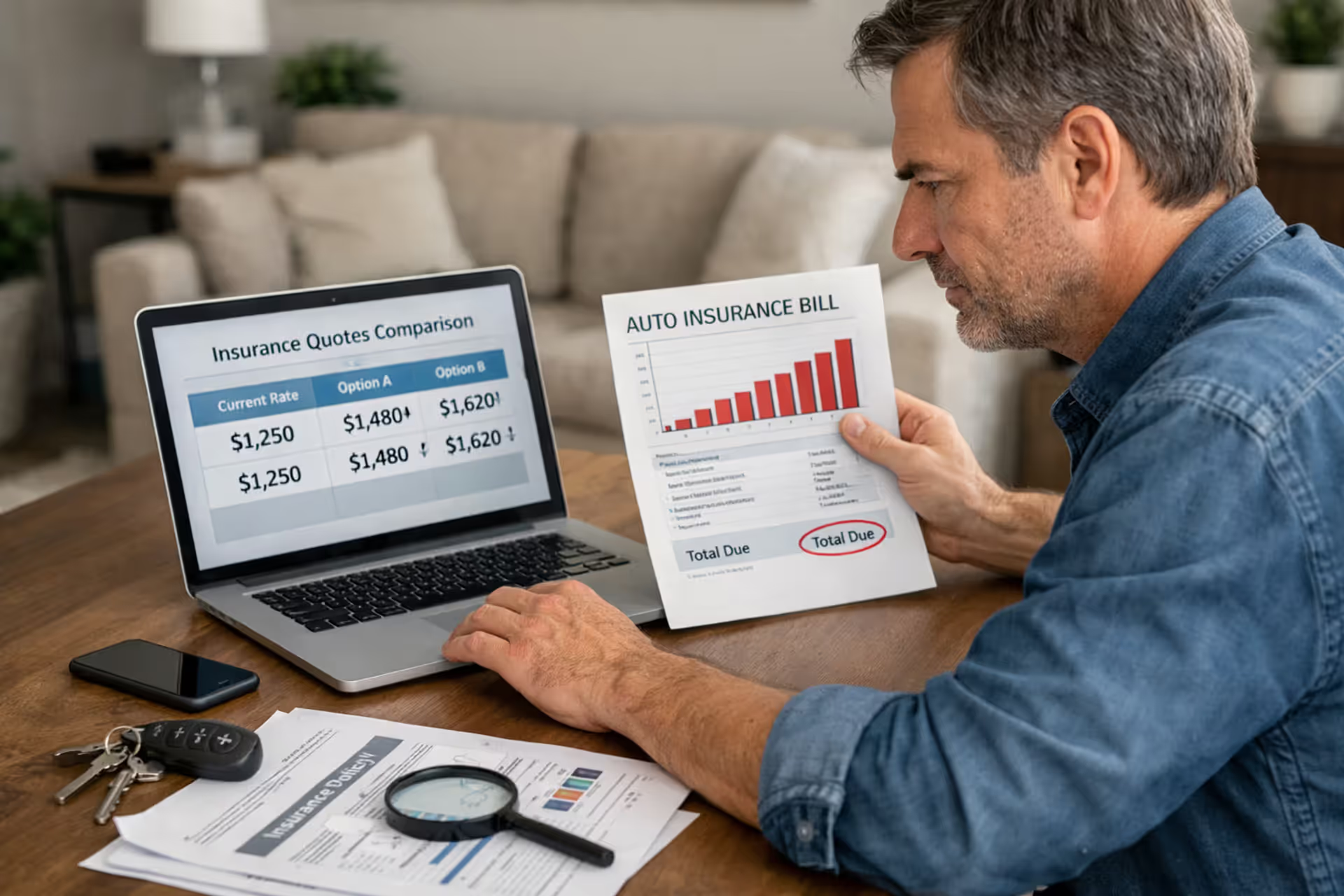
Car insurance cost comparison between younger and older drivers
When Does Car Insurance Go Down for Drivers?

Content
Car insurance premiums follow predictable patterns tied to age, experience, and behavior. Most drivers pay their highest rates between ages 16 and 24, then see substantial decreases as they mature. Understanding these patterns helps you anticipate savings and take steps to accelerate rate reductions.
The average 18-year-old pays roughly $6,000 annually for full coverage, while a 30-year-old with a clean record pays closer to $2,400—a difference of 60%. These drops don't happen randomly. Insurers adjust premiums based on actuarial data showing that certain milestones correlate with safer driving and fewer claims.
How Car Insurance Pricing Works by Age
Insurance companies use age as a primary rating factor because decades of claims data reveal clear patterns. Teenage drivers cause accidents at three times the rate of drivers over 25, making them the riskiest group to insure. This risk translates directly into higher premiums.
The pricing curve starts steep. A 16-year-old driver faces the highest possible rates. Each year without accidents or violations brings modest decreases—typically 5-10% annually—until age 25. After that threshold, the rate of decrease slows but continues through age 30, then levels off considerably.
Insurers recalculate risk profiles at renewal. When you turn 25, your policy doesn't automatically adjust mid-term. The reduction appears when your policy renews after your birthday. If you turned 25 in March but your policy renews in September, you'll see the lower rate in September.
Gender affects these calculations too. Male drivers under 25 pay 14% more on average than females the same age because young men statistically cause more severe accidents. This gap narrows after age 25 and virtually disappears by age 30. Some states—California, Hawaii, Massachusetts, Michigan, Montana, North Carolina, and Pennsylvania—prohibit gender-based pricing entirely.

Author: Trevor Whitfield;
Source: talero.spotpariz.net
Credit-based insurance scores also influence rates in most states. A 25-year-old with excellent credit might pay 40% less than someone the same age with poor credit, even with identical driving records. Insurers view credit management as a proxy for overall risk management.
Key Milestones That Lower Your Car Insurance Rates
Several life events trigger premium reductions beyond simple aging. Insurers adjust rates when your risk profile changes, whether through maturity, stability, or demonstrated responsibility.
Other Life Events That Trigger Rate Decreases
Marriage typically reduces premiums by 7-12%. Insurers view married drivers as more stable and cautious. The discount applies when you update your policy status, not automatically. A 28-year-old who gets married might see their $1,800 annual premium drop to $1,600 simply by notifying their insurer.
Homeownership signals financial stability and reduces rates by 3-5% on average. Insurers assume homeowners maintain better credit, stay with policies longer, and make fewer claims. You'll need to provide proof—a mortgage statement or deed—to qualify.
Completing three years claim-free earns most drivers a 5-8% reduction. After five years without claims, some insurers apply a "preferred" rating that can lower premiums by 15-20%. This clock resets with each at-fault accident or comprehensive claim over $1,000.
Reaching policy anniversaries matters too. Many insurers offer loyalty discounts starting at year three (3-5% off) and increasing at year five (5-10% off). However, these rarely outweigh the savings from shopping around every two to three years.
Moving from urban to suburban or rural areas cuts rates significantly—often 20-30%—because accident frequency drops with population density. A driver paying $2,200 annually in Chicago might pay $1,600 for identical coverage in Springfield.
The single biggest rate drop most drivers experience happens at age 25, when insurers see a measurable decline in accident risk—premiums can fall 15-20% overnight
— Sarah Mitchell
Factors Insurance Companies Review When Adjusting Your Rates
Insurers continuously monitor several variables that affect your premium at each renewal. Understanding these factors helps you influence the direction of your rates.
Your driving record carries the most weight. A single speeding ticket adds 20-25% to your premium for three years. An at-fault accident increases rates by 40-50% for three to five years, depending on severity and state regulations. DUI convictions can triple premiums and stick on your record for five to ten years.
Credit score improvements directly impact rates in 42 states. Raising your score from 580 to 670 might reduce your premium by 15-20%. Insurers typically check credit at renewal, so improvements take six to twelve months to reflect in your rates. Pay down credit card balances below 30% utilization and dispute any errors on your credit report.
Vehicle age affects rates in opposite ways for different coverages. Comprehensive and collision premiums decrease as your car depreciates—a five-year-old car costs 30-40% less to insure for physical damage than when new. However, liability coverage may increase slightly because older cars lack modern safety features.
Claim-free periods compound over time. Each year without a claim slightly improves your risk profile. After three years, you typically qualify for accident forgiveness programs that prevent your first at-fault accident from raising rates. After five years, you've often moved into the lowest risk tier.
Coverage changes affect premiums immediately. Dropping collision and comprehensive on a vehicle worth less than $3,000 can cut your premium by 40-50%. Increasing liability limits from 50/100/50 to 100/300/100 adds only 10-15% but provides substantially better protection.
Annual mileage matters more than most drivers realize. Reducing your annual mileage from 15,000 to 8,000 miles—by switching to remote work, for example—can lower premiums by 8-12%. You'll need to provide proof, such as odometer photos or employer documentation.

Author: Trevor Whitfield;
Source: talero.spotpariz.net
How to Make Your Car Insurance Go Down Faster
Waiting for age-based decreases leaves money on the table. Several proactive steps accelerate rate reductions or uncover immediate savings.
Shop around every two years. Rates vary by 40% or more between carriers for identical coverage. A driver paying $1,800 with one insurer might find the same coverage for $1,200 elsewhere. Loyalty rarely pays—the average driver who switches after three years saves $416 annually.
Complete a defensive driving course approved by your state's DMV. These courses take 4-8 hours online and reduce premiums by 5-10% for three years. Most states require insurers to offer this discount. The course costs $25-50 but saves $150-300 over three years on a $2,000 policy.
Bundle auto with homeowners or renters insurance. Multi-policy discounts range from 15-25%, often saving $300-600 annually. Even if you rent, a $150 annual renters policy combined with auto coverage typically saves $200-300 on the auto portion alone.
Raise your deductible strategically. Increasing from $500 to $1,000 reduces premiums by 10-15%. Going from $500 to $2,000 cuts rates by 25-30%. This makes sense if you have emergency savings to cover the higher deductible and haven't filed a claim in five years.
Ask about usage-based insurance programs. These apps or plug-in devices monitor your driving habits—speed, braking, mileage, time of day. Safe drivers save 10-30% after the monitoring period. The catch: aggressive driving can increase rates or eliminate discounts.
Improve your credit score deliberately. Paying bills on time for six months, reducing credit utilization below 30%, and correcting errors can boost your score enough to lower premiums by 10-20% at your next renewal.
Remove unnecessary coverages. If you're driving a 12-year-old sedan worth $2,500, collision and comprehensive coverage costs more over two years than the car's value. Dropping these coverages saves $400-800 annually with minimal risk.
Increase liability limits while raising deductibles. This counterintuitive move provides better protection where it matters—covering injuries and property damage to others—while reducing overall cost. Going from 50/100/50 liability with a $500 deductible to 250/500/100 liability with a $1,500 deductible often costs less monthly.
Common Mistakes That Keep Your Premiums High
Many drivers inadvertently maintain higher rates through inaction or misconceptions about how insurance works.
Staying with the same insurer beyond three years without shopping costs you money. Insurers offer the lowest rates to attract new customers, then gradually increase premiums for existing policyholders. Even if you're satisfied with service, comparing quotes every 24 months ensures you're not overpaying by 20-40%.
Not reporting life changes leaves discounts unclaimed. Got married? Premium should drop. Moved to a safer neighborhood? Premium should drop. Paid off your car loan? You can now adjust coverage. Insurers don't proactively search for reasons to lower your rate—you must inform them.
Maintaining full coverage on vehicles that don't warrant it wastes hundreds annually. The rule of thumb: if your car's value is less than ten times your annual collision and comprehensive premium, drop those coverages. For a car worth $3,000, if you're paying more than $300 annually for collision and comprehensive, you're better off self-insuring.
Ignoring small tickets or violations until renewal surprises you with a 25% increase. Many states allow traffic school to keep tickets off your insurance record if you act within 30-60 days. Once it hits your record, you'll pay elevated rates for three years.
Setting autopay and forgetting your policy means missing gradual rate creep. Insurers increase premiums by 3-7% annually even without claims, betting you won't notice. Review your declaration page at each renewal and question any increases not explained by coverage changes.
Accepting the first quote without negotiating leaves savings on the table. When you receive a renewal notice with an increase, call your agent. Simply asking "Can you find me a better rate?" often uncovers discounts you hadn't been applying or prompts them to requote with a different underwriting tier.
Understanding Deductibles and Coverage Limits Impact on Premiums

Author: Trevor Whitfield;
Source: talero.spotpariz.net
Your deductible—the amount you pay before insurance kicks in—inversely affects your premium. Higher deductibles mean lower monthly costs but more out-of-pocket expense if you file a claim.
| Deductible Amount | Estimated Monthly Premium | Annual Premium | Out-of-Pocket Per Claim |
| $250 | $185 | $2,220 | $250 |
| $500 | $165 | $1,980 | $500 |
| $1,000 | $145 | $1,740 | $1,000 |
| $2,000 | $125 | $1,500 | $2,000 |
Based on average rates for a 30-year-old driver with full coverage on a mid-size sedan in 2026
The math favors higher deductibles if you have emergency savings and file claims rarely. Increasing your deductible from $250 to $1,000 saves $480 annually. You'd need to file a claim more than once every 1.6 years for the lower deductible to pay off—but most drivers go 8-10 years between collision claims.
Coverage limits work differently. These represent the maximum your insurer pays per accident. State minimums—often 25/50/25 (meaning $25,000 per person for injuries, $50,000 total per accident, $25,000 for property damage)—barely cover a serious accident. A multi-car pileup or injury accident easily exceeds these limits, leaving you personally liable for the difference.
Increasing liability limits costs far less than most drivers expect. Going from minimum 25/50/25 to recommended 100/300/100 typically adds only $15-25 monthly—$180-300 annually—but provides four times the protection. Umbrella policies offering $1-2 million in additional liability cost just $200-400 annually.
The sweet spot for most drivers: $1,000 deductibles on collision and comprehensive (if the vehicle warrants these coverages), with 100/300/100 or 250/500/100 liability limits. This combination balances affordability with meaningful protection.
What to Expect During the Claims Process
Filing a claim triggers a rate increase in most cases, but the impact varies by claim type and your history. Understanding this helps you decide whether to file or pay out-of-pocket for minor damage.
At-fault collision claims increase premiums by 40-50% for three to five years. A driver paying $1,500 annually might see rates jump to $2,100-2,250. Over three years, that's an additional $1,800-2,250 in premiums. If the damage costs less than $2,000 and you have a $1,000 deductible, you'd pay $1,000 out-of-pocket plus $1,800-2,250 in increased premiums—a total cost of $2,800-3,250 to recover $1,000.
Not-at-fault accidents still raise rates in some states, though less dramatically—typically 10-20%. This seems unfair, but insurers view any accident involvement as a risk indicator. Twelve states prohibit rate increases for not-at-fault accidents: California, Oklahoma, Massachusetts, Michigan, New York, Connecticut, Hawaii, Kansas, Kentucky, Louisiana, Oregon, and Vermont.
Comprehensive claims (theft, vandalism, weather damage, animal strikes) impact rates less than collision claims—usually 5-15% increases. Glass-only claims often don't affect rates at all, especially if you have a zero-deductible glass coverage endorsement.
Accident forgiveness programs prevent your first at-fault accident from raising rates. Most insurers offer this after three to five years claim-free, though some charge $50-100 annually for the endorsement. If you have accident forgiveness and file a claim, your rates stay level, but you lose the forgiveness benefit going forward.
Rate increases persist for three to five years depending on state regulations and insurer policy. After this period, the claim "falls off" your record and rates return to pre-accident levels—assuming you haven't filed additional claims. Some insurers reduce the surcharge incrementally: 50% of the increase in year one, 30% in year two, 20% in year three.
The claims process itself takes two to six weeks for straightforward cases. You'll report the claim, receive an adjuster assignment within 24-48 hours, get a damage estimate, and receive payment minus your deductible. The rate increase appears at your next renewal, typically 30-90 days after the claim closes.
Frequently Asked Questions About Car Insurance Rate Decreases
Car insurance premiums follow predictable patterns tied to age, experience, and behavior. The most dramatic decrease happens at 25, when rates typically drop 15-20% overnight. Additional reductions come at 30, with marriage, homeownership, and each year you remain claim-free.
You don't have to wait passively for these decreases. Shopping around every two years, bundling policies, raising deductibles strategically, and completing defensive driving courses accelerate savings. Small actions—improving credit scores, reducing annual mileage, or dropping unnecessary coverage on older vehicles—compound over time.
The key is treating insurance as an active financial decision rather than a set-it-and-forget-it expense. Review your policy at each renewal, question increases, report life changes promptly, and compare quotes regularly. Drivers who do this consistently pay 20-40% less than those who remain with the same insurer for years without reviewing coverage.
Your rates will naturally decrease as you age and gain experience, but proactive management ensures you're not leaving hundreds of dollars on the table while you wait.