
Homeowners insurance concept with suburban house and policy documents
How Much Is Homeowners Insurance?

Content
The average American homeowner now pays around $2,377 yearly for insurance coverage—but that national figure masks wild swings. You might pay just $800 in Hawaii or fork over $5,000+ in Florida. Geography matters tremendously, but so do your home's age, construction quality, and the coverage choices you make. Understanding what drives these costs puts real money back in your pocket (we're talking $300-$600 annually) without leaving you underprotected when disaster strikes.
What Factors Determine Your Homeowners Insurance Cost
Insurers crunch dozens of variables when pricing your policy. Some move the needle dramatically; others barely register.
Home Characteristics That Affect Premiums
Age matters—a lot. That charming 1960s ranch with original wiring and old galvanized pipes? It'll cost you more than the new construction down the street with modern electrical, updated plumbing, and current building codes baked in.
Your exterior walls make a difference too. Brick and stone homes typically earn discounts compared to wood siding, which burns easier and suffers more wind damage. One client I know saved $180 yearly just by re-siding their home with fiber cement instead of vinyl.
Square footage affects cost, but it's not linear. Double your home from 2,000 to 4,000 square feet and your premium won't double. Why? Because you're not adding two more kitchens and three more bathrooms—the expensive stuff. Expect maybe a 40-50% bump, not 100%.
Your roof deserves special attention. Insurers now routinely ask: "How old is your roof?" Shingles over 15 years old? Expect higher premiums or coverage restrictions. Just replaced your roof? You might snag a 10% discount. In hail-prone Colorado and Texas, carriers increasingly require impact-resistant shingles just to write the policy.
Location and Risk Factors
Even within the same city, premiums swing wildly based on micro-local factors:
Fire protection matters immensely. Live within five miles of a professional fire department and 1,000 feet from a hydrant? Good. You'll pay less. Rural homes depending on volunteer firefighters face significant surcharges.
Crime statistics follow you. Your specific ZIP code's theft and vandalism rates directly impact what you'll pay. Two neighborhoods separated by a highway might see 25% premium differences purely based on property crime data.
Natural disasters cast a long shadow. Distance from the coast, flood zone status, earthquake fault lines, wildfire risk maps, tornado frequency—all of it matters. Sometimes you'll need separate policies for certain perils, but even if you're outside high-risk zones, living in a state prone to these disasters pushes your baseline premium up.
Local rebuilding costs vary enormously. Rebuilding the exact same home costs three times more in San Francisco than in rural Mississippi because of labor rates and material costs. That reality forces higher coverage limits and bigger premiums.
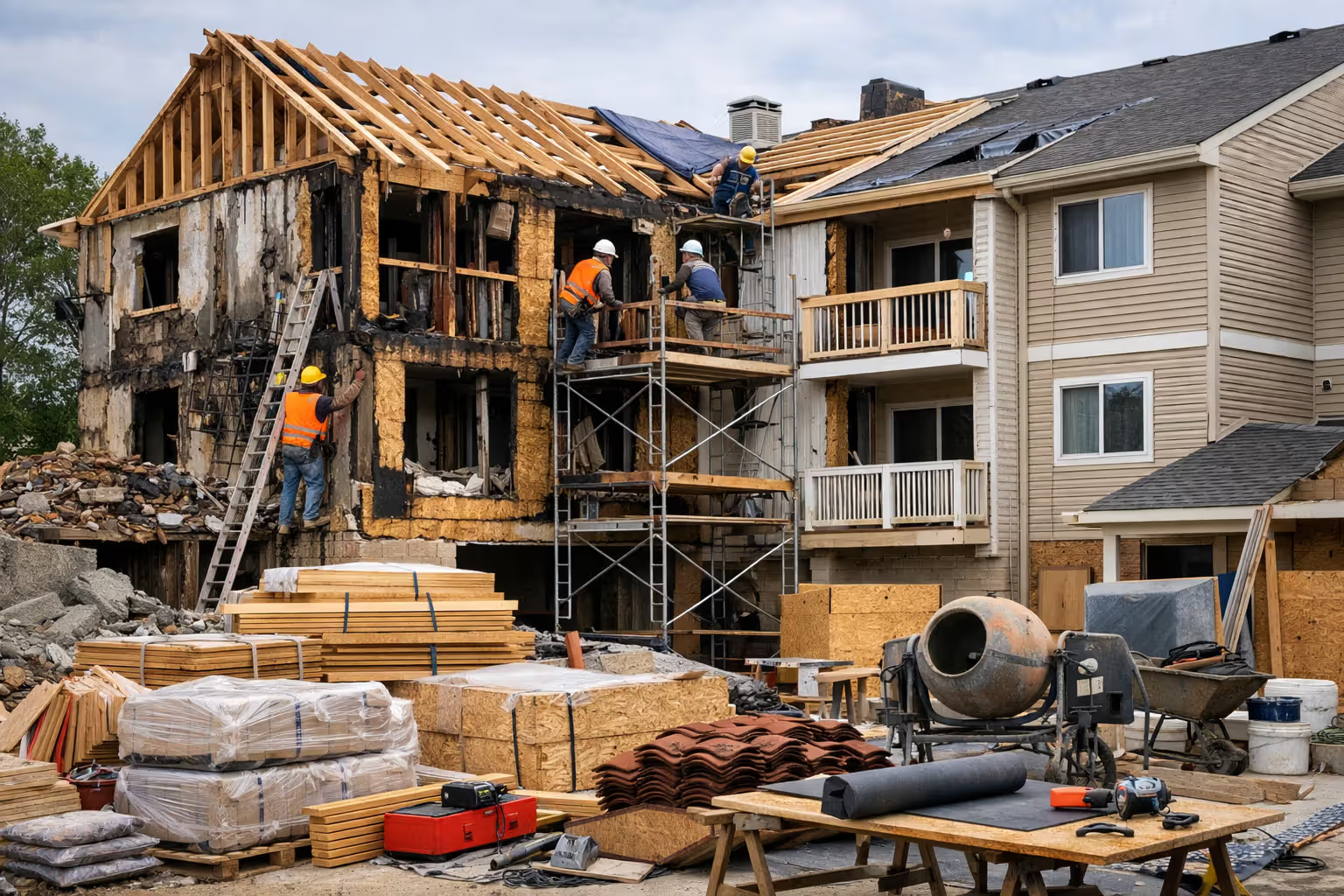
Author: Nathaniel Porter;
Source: talero.spotpariz.net
Coverage Amount and Policy Type
Higher limits mean higher premiums, but the relationship isn't perfectly proportional. Bumping your dwelling coverage from $250,000 to $300,000 might only add $150 annually since the insurer's overhead stays fixed.
Policy form creates big differences. Most people get HO-3 policies—they cover your house against all risks except specific exclusions, while your stuff gets "named peril" coverage (only listed events are covered). Upgrade to HO-5 for comprehensive coverage on everything, and you'll pay 10-15% more. HO-8 policies for older homes use actual cash value instead of replacement cost, cutting premiums but also slashing what you'd receive after a claim.
Average Cost of Homeowners Insurance by State
Geography isn't just important—it's often the single biggest factor in what you'll pay. Coastal states hammered by hurricanes and regions sitting in tornado alleys face brutal premium costs, while states with mild weather and fewer natural disasters offer gentler rates.
| State | Annual Premium Average | Cost Category |
| Florida | $4,891 | Highest Cost |
| Louisiana | $4,456 | Top Tier |
| Texas | $3,842 | Top Tier |
| Oklahoma | $3,687 | High Cost |
| Kansas | $3,321 | High Cost |
| Colorado | $3,156 | Above Average |
| Nebraska | $2,988 | Above Average |
| Mississippi | $2,876 | Above Average |
| Alabama | $2,743 | Above Average |
| South Dakota | $2,654 | Mid-Range |
| National Average | $2,377 | Mid-Range |
| Georgia | $2,289 | Mid-Range |
| North Carolina | $2,103 | Below Average |
| Arizona | $1,876 | Below Average |
| Ohio | $1,654 | Low Cost |
| Wisconsin | $1,432 | Low Cost |
| Oregon | $1,287 | Very Low |
| Utah | $1,198 | Very Low |
| Idaho | $1,067 | Bargain |
| Hawaii | $897 | Lowest Cost |
Florida's insurance market has basically imploded. Premiums have doubled since 2020—a mess created by back-to-back hurricanes, lawsuit abuse driving up claims costs, and major carriers like State Farm pulling out entirely. Meanwhile, Hawaii sits at the opposite end. Despite being surrounded by ocean, the state benefits from strict building codes, low crime, and surprisingly calm weather (volcanic zones aside).
Understanding Homeowners Insurance Coverage and Limits
Too many homeowners obsess over the premium without understanding what they're actually buying. Standard policies split into six distinct buckets:
Dwelling coverage (Coverage A) pays to rebuild your house. This should match reconstruction cost—what it would take to build from scratch—not your home's market value. A $400,000 house in a hot market might need only $280,000 in dwelling coverage because you're not insuring the land underneath.
Other structures (Coverage B) typically gives you 10% of your dwelling limit for detached garages, sheds, fences, and similar items. Got a massive workshop or barn? You can buy more.
Personal property (Coverage C) usually provides 50-70% of dwelling coverage for your belongings. So $300,000 in dwelling coverage means $150,000-$210,000 for furniture, clothes, electronics. Watch out—jewelry, art, and collectibles have sub-limits, typically $1,500-$2,500 per category unless you buy extra coverage.
Additional living expenses (Coverage D) covers hotel bills, restaurant meals, and related costs if your home becomes unlivable. Usually 20% of your dwelling amount. This saved my neighbor $18,000 when a kitchen fire forced them into a hotel for three months.
Liability protection (Coverage E) protects your assets when someone gets hurt on your property or you damage their belongings. Standard policies include $100,000-$300,000, but bumping it to $500,000 or $1 million costs surprisingly little—often just $50-$100 more annually.
Medical payments (Coverage F) handles minor guest injuries without requiring a liability determination—typically $1,000-$5,000 per person.
Replacement cost versus actual cash value represents a crucial fork in the road. Replacement cost gives you money to buy new equivalent items at today's prices. Actual cash value deducts depreciation first, sometimes cutting payouts in half. That 10-year-old roof needing $15,000 to replace? Actual cash value might deliver only $7,500 after depreciation. Replacement cost coverage adds 10-15% to premiums but eliminates nasty surprises when you're filing claims.

Author: Nathaniel Porter;
Source: talero.spotpariz.net
How Deductibles Impact Your Premium
Your deductible—what you pay before insurance kicks in—is probably your easiest cost-control lever. Most insurers offer deductibles from $500 to $5,000, with $1,000 being most common.
| Deductible Amount | Annual Premium Estimate | Yearly Savings Compared to $500 | Break-Even Timeline |
| $500 | $2,450 | Baseline | N/A |
| $1,000 | $2,180 | $270 | 1.9 years |
| $2,500 | $1,890 | $560 | 4.5 years |
The math is straightforward. Jumping from a $500 to $1,000 deductible saves $270 yearly but increases your out-of-pocket risk by $500 per claim. If you avoid filing claims for about two years, you come out ahead. Since typical homeowners file claims once every nine years, higher deductibles make financial sense if you've got adequate emergency savings.
A $2,500 deductible delivers bigger savings but demands careful thought. Here's the thing: filing small claims often backfires because insurers raise rates or drop coverage after multiple claims. Many homeowners now treat insurance as catastrophic protection, paying for minor repairs themselves to maintain clean claims histories.
Certain regions force percentage-based deductibles (1-5% of dwelling coverage) for hurricanes or hail. A 2% deductible on $300,000 dwelling coverage means you're covering the first $6,000 of storm damage yourself—a reality that catches many homeowners off guard.

Author: Nathaniel Porter;
Source: talero.spotpariz.net
What Does Homeowners Insurance Actually Cover
Standard policies protect against specific perils, but exclusions trip up countless homeowners every year.
You're typically covered for: - Fire and smoke damage - Lightning strikes - Wind and hail destruction (though coastal policies may exclude wind) - Theft and vandalism - Vehicle or aircraft crashing into your house - Falling objects (like trees) - Ice, snow, and sleet damage - Burst pipes or sudden appliance malfunctions - Electrical surges
Common exclusions that surprise people: - Flooding (you need separate NFIP or private flood insurance) - Earthquakes (requires standalone policy or endorsement) - Sewer backup (usually available as add-on for $50-$100 yearly) - Mold and fungus (covered only when caused by covered events, with strict caps) - Normal wear and tear or deferred maintenance - Intentional damage - Home business operations (need commercial coverage) - Certain dog breeds (some carriers exclude pit bulls, Rottweilers, others)
Water damage confuses everyone. Burst pipe flooding your kitchen? Covered. Groundwater seeping through basement cracks? Not covered—that's considered flooding. Storm-driven rain leaking through your roof? Covered. Leak from a roof you should've replaced years ago? Probably not covered. These distinctions fuel endless claim disputes.
How to Lower Your Homeowners Insurance Costs
Besides adjusting deductibles, you've got multiple paths to trimming premiums without sacrificing essential protection:
Bundle policies. Combining home and auto with one carrier typically saves 15-25% on both. Add umbrella liability coverage and discounts often increase further.
Upgrade security. Monitored alarm systems, deadbolts, interconnected smoke detectors, and fire extinguishers can earn 5-20% discounts. Smart home tech detecting water leaks or monitoring for break-ins increasingly qualifies for reductions.
Modernize critical systems. Replacing outdated electrical panels, old plumbing, or aging HVAC lowers risk and often cuts premiums. Some insurers offer specific discounts for impact-resistant roofs, hurricane shutters, or fortified construction meeting IBHS standards.
Improve your credit. Most states let insurers use credit-based insurance scores. Boosting your credit can slash premiums 20-30% in some cases.
Review coverage annually. Your home's reconstruction cost might not rise as fast as your premiums. If construction costs have stabilized or you've paid down your mortgage significantly, modest coverage adjustments might work. But don't underinsure—that creates devastating financial risk.
Ask about every possible discount. Carriers maintain dozens of discount programs agents don't always mention: long claims-free periods (3-5 years), loyalty rewards, professional memberships, retiree discounts, and more.
Shop around religiously. Loyalty doesn't pay in insurance. Getting quotes from three to five carriers every two to three years ensures you're not overpaying. Identical coverage can vary by $1,000+ across companies.
Explore group policies. Some employers, alumni groups, and professional associations negotiate group homeowners insurance with better rates.
Homeowners who thoroughly compare the market every three years save an average of $400 annually compared with those who stick with the same insurer indefinitely. Competition exists, but you have to actively seek it—carriers won't voluntarily lower your rate just because better deals exist elsewhere
— Sarah Mitchell
Filing a Homeowners Insurance Claim: What to Expect
Understanding the claims process before disaster hits makes navigating it during crisis much easier.
Step 1: Document everything immediately. Take photos and videos from multiple angles before making temporary repairs. Create detailed lists of damaged items including when you bought them and what you paid.
Step 2: Prevent further damage. Your policy requires you to stop additional harm—tarp damaged roofs, board broken windows, shut off water. Save receipts for emergency repairs; they're typically reimbursable.
Step 3: Contact your insurer promptly. Most policies require "prompt" notice, interpreted as within a few days. You'll get a claim number and adjuster assignment.
Step 4: Meet with the adjuster. The adjuster will inspect damage, take measurements, and estimate repair costs. Be present and point out all damage—adjusters work hard but can miss things, especially in major losses.
Step 5: Review settlement offers carefully. Insurers often issue initial payments for obvious damage, then final settlements after repairs finish. Scrutinize estimates—you can dispute lowball offers using independent contractor quotes or hiring public adjusters (who take 10-15% of settlements but may substantially increase payouts).
Step 6: Complete repairs and document completion. Most policies pay replacement cost in two phases: actual cash value up front, then depreciation holdback after you prove repairs with receipts and photos.
Typical timelines: - Simple claims (small water damage, theft): 2-4 weeks - Medium claims (kitchen fires, storm damage): 4-8 weeks - Major claims (total losses, extensive damage): 2-6 months
Keep meticulous records of every conversation—adjuster names, dates, what was discussed. If your claim gets denied or the settlement seems low, you can request re-inspection, file complaints with your state insurance department, or consult attorneys specializing in insurance disputes.

Author: Nathaniel Porter;
Source: talero.spotpariz.net
Frequently Asked Questions About Homeowners Insurance Costs
Homeowners insurance costs have climbed steeply, but grasping what drives premiums helps you control expenses effectively. Geographic location exerts the strongest influence—living in high-cost states guarantees elevated premiums regardless of other factors. Beyond location, your coverage decisions, deductible choices, property characteristics, and comparison shopping habits determine whether you're getting good value or dramatically overpaying.
The worst mistake? Underinsuring to save on premiums. The second worst? Staying with the same insurer year after year without comparing rates. Annual policy reviews, consistent property maintenance that reduces risk, and multi-carrier quotes every few years represent simple habits that can save thousands over time while ensuring adequate protection when losses strike.