
Driver comparing car insurance quotes on a laptop at home
How to Switch Car Insurance Without Losing Coverage?

Content
Every year, roughly 30% of drivers who bother to compare insurance quotes discover they've been overpaying—sometimes by $400, sometimes by $900. Yet most people renew automatically, year after year, with the same company. Maybe you trust your current insurer. Maybe shopping around sounds tedious. Here's the thing: switching takes about as long as watching a Netflix episode, and unlike that show, it actually puts money back in your pocket.
The mechanics aren't complicated. You get new quotes. You buy a new policy. You cancel the old one. But—and this matters more than you'd think—the order and timing of those steps determine whether you save money cleanly or create problems that cost more than you saved. Cancel too early? You're driving uninsured, which is both illegal and financially catastrophic if something goes wrong. Rush through comparing quotes without matching coverage details? That "cheaper" policy might leave you holding the bill after your next fender-bender.
Let's walk through how to do this right, step by step, so you keep the savings without the headaches.
When You Should Consider Switching Car Insurance
You can switch whenever you want, but certain situations should prompt you to at least peek at what else is out there.
Your renewal notice shows a price jump you didn't expect. Maybe your premium climbed 18% and you haven't had an accident, ticket, or new driver in the household. Insurers constantly recalibrate their rates based on aggregate loss data, inflation, and their own profit targets. Sometimes you're just unlucky—you fall into a demographic segment they've decided to charge more. Other companies might still consider you a great risk. Worth checking.
You've changed addresses, even locally. Insurance pricing is hyper-local. Move from one side of town to another and your rate can swing 25% in either direction. Different neighborhoods mean different theft rates, different accident frequencies, different weather exposure. Your insurer will adjust your rate when you report the move, but they might not stay competitive in your new ZIP code. Five minutes of quote-shopping beats assuming they're still your best option.
Your life changed in a way that affects risk. Got married last year? Turned 25? Bought a house? Paid off your credit cards? Each of these can qualify you for lower rates, but insurers weight them differently. Your current company might give you a 5% marriage discount while a competitor offers 12%. You won't know unless you look.
You added or dropped a vehicle. The insurer that gave you a great rate on your 2015 Civic might be expensive for your new truck. Insurance companies specialize—some are cheaper for sedans, others for SUVs, some for families with teens. Your old policy's competitive rate doesn't automatically transfer to your new vehicle lineup.
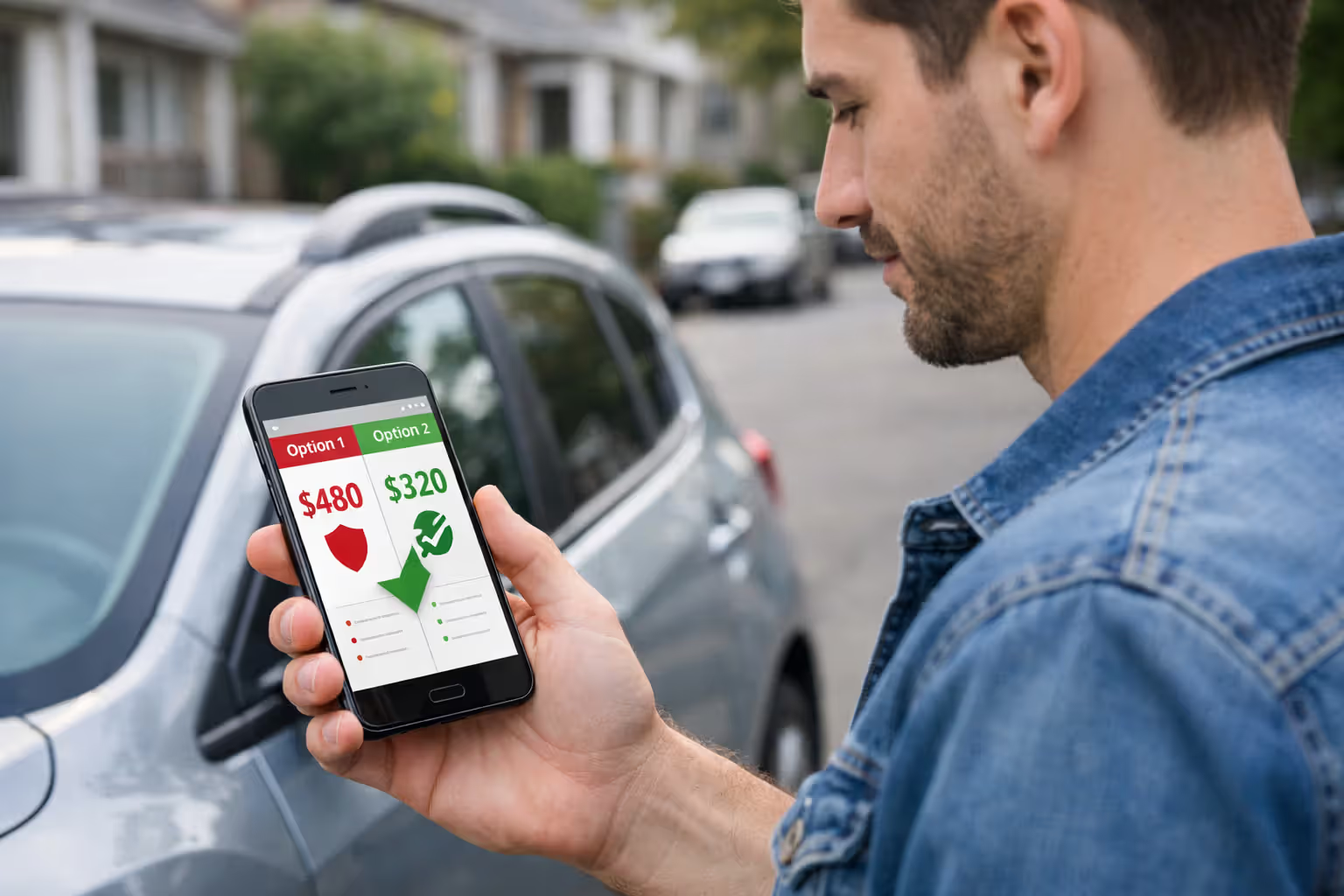
Someone offered you a substantially better quote. This is the simplest reason. If you're paying $1,580 a year and a solid, reputable company quotes you $1,140 for identical coverage, switch. Insurance is a commodity. Brand loyalty is fine when it's free, but not when it costs you $440 annually.
Author: Nathaniel Porter;
Source: talero.spotpariz.net
Steps to Switch Your Car Insurance Policy
Follow this sequence. Skipping or reordering these steps causes problems.
Step 1: Get quotes from three to five insurers for coverage that matches what you have now. Write down your current liability limits—they'll look something like 100/300/100. Note your collision deductible. Note your comprehensive deductible. Write down every add-on: rental coverage, roadside assistance, whatever. Give these exact same specifications to every company you quote. If you request different coverage from each, comparing prices becomes meaningless.
Step 2: Pull out your current policy documents and check two things: your policy expiration date and the cancellation clause. Most policies have a six-month or twelve-month term. Most allow mid-term cancellation with a prorated refund, but some charge a flat $50 fee or keep a percentage of unused premium as a penalty. You need to know this before deciding when to switch.
Step 3: Look at your payment schedule. If you pay monthly and your insurer auto-drafts on the 15th, you want to time your cancellation so you're not paying for coverage you're not using. Don't cancel the auto-pay yet—if you do that before officially canceling the policy, you could accidentally lapse your coverage.
Step 4: Buy your new policy with a start date that lines up with—or slightly overlaps—your old policy. Most people switching mid-term should set the new policy to start the day before they plan to cancel the old one. Yes, you'll pay for one day of double coverage. That costs maybe $3-8. A coverage gap, even for a few hours, can cost you thousands if something happens, and it creates a lapse on your record that increases your rates for years.
Step 5: Wait until you have actual proof of insurance from your new company. A quote isn't enough. A binder isn't enough. You need the real policy documents and insurance card in hand (or email, more likely) before moving to the next step.
Step 6: Contact your old insurer to cancel. Call them, then follow up in writing through email or their online account portal. State the exact cancellation date. Ask them to confirm the date in writing and tell you how much your refund will be.
Step 7: Verify everything a week later. Confirm they processed the cancellation on the correct date. Check that the refund amount matches what they promised. Insurers are human organizations—data entry errors happen, and you don't want to discover a mistake three months later when fixing it requires six phone calls and a supervisor review.
Documents You'll Need to Switch
Having these ready speeds up the quoting process considerably:
- Your current declarations page (it shows all your coverage details in one place)
- Driver's license numbers for everyone in your household who drives
- VINs for all vehicles you're insuring
- Current odometer readings and where you park each vehicle overnight
- Specifics on any accidents or moving violations from the past five years (dates and basic details)
- Your current insurer's name and policy number to prove you've had continuous coverage
Many insurers offer a "continuous coverage" discount—basically a reward for not driving uninsured. Proving you've been insured without gaps for the past year can save you 5-15%.
How to Avoid a Coverage Gap
A gap is any period, even a single day, when you don't have active insurance. Gaps create two separate problems. First, you're personally on the hook for all damages if you drive during that period—medical bills, vehicle repairs, property damage, everything. Second, insurers treat gaps as a red flag indicating higher risk, and they'll surcharge your rate 15-40% for the next three to five years, or sometimes refuse to insure you at all.
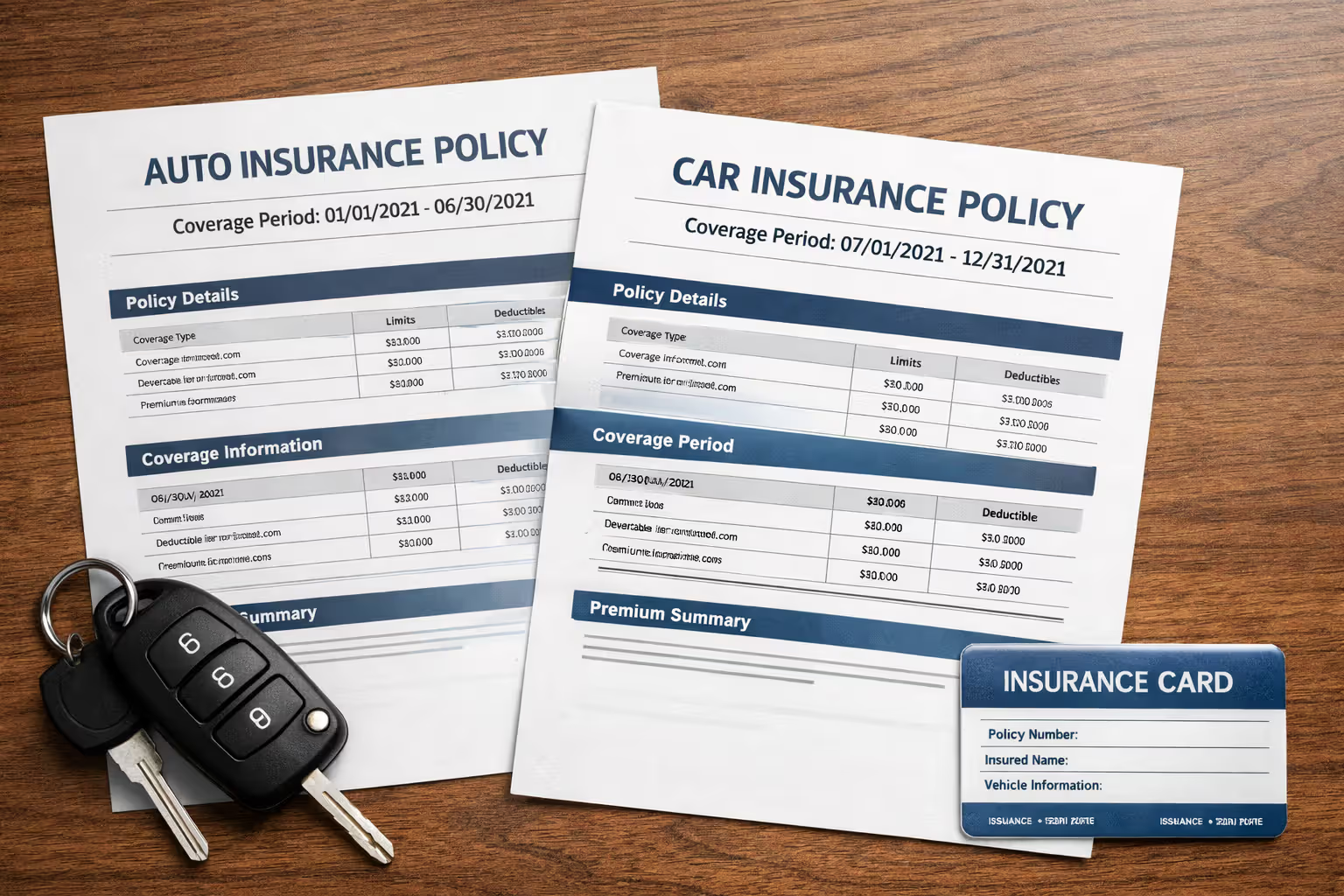
The fix is dead simple: never let your old policy end before your new one begins. Overlap them by a day. Set your new policy's effective date for the day before you cancel the old one. The cost of overlapping for one day is trivial. The cost of a gap is potentially catastrophic.
Author: Nathaniel Porter;
Source: talero.spotpariz.net
If you're parking a car for a few months and not driving it, don't cancel everything. Remove collision and comprehensive if you want to save money, but keep liability active. This preserves your continuous coverage record while cutting your premium substantially.
Understanding Your Current Policy Before You Switch
You can't tell if a new policy is better until you understand what you already have.
When you file a collision or comprehensive claim, your deductible is what you pay before insurance contributes anything. Say you back into a pole and cause $2,100 in damage to your car. If your collision deductible is $500, you write a check for $500 and insurance covers the remaining $1,600. Higher deductibles mean lower premiums but more out-of-pocket cost when you claim. Jumping from a $250 deductible to $1,000 might cut your premium 20-35%, which sounds great until you need to file a claim and suddenly you're covering that first $1,000 yourself.
Liability limits set a ceiling on how much your insurer pays per claim. Those three numbers—like 100/300/100—represent thousands of dollars. First number: maximum paid per person for bodily injury. Second number: maximum per accident for all injuries combined. Third number: maximum for property damage. So 100/300/100 means up to $100k per injured person, $300k total per accident for injuries, and $100k for property damage. Anything beyond these limits comes out of your bank account—your wages can be garnished, your house can be liened, your savings seized. Many states require only 25/50/25, which is woefully inadequate. You cause a three-car pileup with two serious injuries and you could easily face $500,000 in claims. Your 25/50/25 policy pays $50,000 total. You're personally liable for the other $450,000.
Refund calculations depend on your insurer's cancellation policy. Most use pro-rata, which means they refund exactly the unused portion. Pay $1,200 for six months, cancel after two months, get back roughly $800. Some use short-rate cancellation—they keep an extra 5-10% as a penalty for canceling mid-term. Check your policy's fine print.
The single biggest mistake I see is people canceling their old policy on Monday and starting their new one on Tuesday. They think they're being efficient. What they're actually doing is creating a one-day gap that flags them as a lapsed driver, and that follows them for three years. Overlap by a day. It costs almost nothing and saves you from a world of pain
— Jennifer Martinez
What Happens to Your Claims and Deductible When You Switch
Switching doesn't erase your history or carry over your deductible—but it does create some situations you should understand going in.
Open claims stay with the insurer you had when the incident happened. If you filed a claim three weeks ago and now you switch to a new company, your old insurer still handles that claim through completion. The claim doesn't follow you to your new policy. This can get awkward. You're no longer their customer, which means you're no longer a priority when they're allocating adjuster time. Repairs get delayed. Calls take longer to get returned. If you have an active claim, consider whether it's worth switching immediately or better to wait until it's settled, unless your savings are substantial enough to offset the inconvenience.

Author: Nathaniel Porter;
Source: talero.spotpariz.net
Deductibles reset with each new policy. If you paid a $500 deductible for repairs last month under your old policy and then switch insurers, you don't get that $500 credited toward your next claim. Each policy is independent. This matters if you have damage that you haven't gotten fixed yet—switching won't help you avoid paying another deductible.
Your claims history is tracked nationally through CLUE (Comprehensive Loss Underwriting Exchange). Every insurer can see every claim you've filed in the past five to seven years, regardless of which company you were with at the time. An at-fault accident or multiple small claims will increase your rate no matter where you go. That said, insurers penalize claims differently. One might surcharge your rate 50% after an at-fault accident; another might add only 25%. If your current company jacked your rate way up after a claim, absolutely shop around. You'll pay more everywhere, but potentially less than you're paying now.
Sometimes switching right after a claim actually saves money. Your current insurer might have raised you to $1,850 annually after your accident. A competitor sees the same accident history but quotes you $1,480. The accident hurts your rate everywhere, but they're still cheaper overall.
Comparing Coverage Limits and Costs Across Insurers
Two quotes are only comparable when they include identical protection. An $850 annual premium with 50/100/50 limits isn't cheaper than a $1,150 premium with 250/500/100 limits—it's just less insurance. You can't compare them.
Match these exactly when quoting:
- Bodily injury liability limits (both per-person and per-accident)
- Property damage liability limit
- Collision deductible
- Comprehensive deductible
- Uninsured and underinsured motorist coverage
- Medical payments or PIP (personal injury protection)
- Any extras like towing, rental reimbursement, gap coverage
Ask each insurer for a detailed breakdown showing what each piece costs. This reveals where the real differences are. Maybe Company A charges less for liability but significantly more for collision. If you drive a 12-year-old car and you're thinking about dropping collision anyway, Company A might be your best bet even if their total quote is slightly higher.
| Coverage Type | What It Pays For | Common Limit Options | Is It Mandatory? |
| Bodily Injury Liability | Medical costs, lost income, pain/suffering when you hurt someone | 25/50 up to 500/500 (in $1,000s) | Yes in most states |
| Property Damage Liability | Repairs to other people's cars/property you damage | $10,000 to $100,000 | Yes in most states |
| Collision | Repairs to your vehicle after crashes, regardless who's at fault | Deductible: $250–$2,000 | Optional, but lenders require it |
| Comprehensive | Damage from theft, vandalism, hail, hitting a deer | Deductible: $250–$2,000 | Optional, but lenders require it |
| Uninsured Motorist | Your injuries when someone without insurance hits you | Usually matches your liability limits | Mandatory in some states |
| Medical Payments | Your medical bills after an accident regardless of fault | $1,000 to $10,000 | Optional in most places |
Think hard about raising your liability limits when you switch. The premium difference between 50/100/50 and 100/300/100 is often only $90-180 per year. That's tiny compared to the financial protection you gain. If you own a home, have retirement savings, or possess any assets someone could go after in a lawsuit, carry enough liability to shield them. One bad crash can generate a lawsuit seeking $600,000 or more. State minimum coverage won't protect you.
Common Mistakes to Avoid When Switching Car Insurance
These are the errors that turn a smart financial decision into an expensive mess:
Canceling first, buying later. Even one day without coverage creates a lapse on your record that increases your rates for years. It also leaves you personally liable for any damage you cause during that gap. Overlap coverage by a day instead of trying to time it perfectly.
Requesting different coverage levels from each insurer. You can't determine which company is cheaper unless you're comparing identical protection. One insurer quotes 50/100/50 limits for $900, another quotes 100/300/100 for $1,100—which is better? You can't answer that because it's not an apples-to-apples comparison. Write down your current coverage specs and request identical coverage everywhere.
Forgetting to ask about discounts. Bundling with homeowners insurance, paying your premium in full upfront, enrolling in automatic payments, taking a defensive driving course, or agreeing to use a telematics device can each save 5-20%. Ask every insurer about every available discount before deciding. Some won't mention them unless you specifically ask.
Switching mid-term without calculating the actual savings. If your current insurer charges a $75 cancellation penalty and you're only saving $110 annually with the new policy, you won't break even for about eight months. Sometimes waiting until renewal costs you nothing in fees and makes more sense.
Not notifying your lender. If you finance or lease your vehicle, the lender must be listed on your policy as the lienholder or loss payee. When you switch, you need to tell them and send proof of the new coverage. Skip this and they'll buy expensive force-placed insurance and bill you for it, sometimes without even notifying you first.
Assuming longevity earns you better rates. Insurance companies routinely charge long-term customers more than new customers because they offer aggressive acquisition discounts to attract fresh business. Your eight years of loyalty might mean absolutely nothing to your rate. In fact, you might be subsidizing the discounts they're using to lure new customers. Shop around even if you like your current company.
Reading only the declarations page of your new policy. When your new policy documents arrive, read the actual policy language, not just the summary page. Look for coverage exclusions, limitations, and claim procedures that differ from what you expected. Occasionally what was quoted isn't exactly what was delivered, and you want to catch that immediately, not after you file a claim.

Author: Nathaniel Porter;
Source: talero.spotpariz.net
Frequently Asked Questions About Switching Car Insurance
Switching your car insurance is one of the easiest ways to cut annual expenses without giving anything up. The process demands attention to detail—matching coverage precisely, timing the switch to prevent gaps, understanding refund policies—but nothing about it is complicated or requires specialized knowledge. Most people who switch pocket between $250 and $600 per year, and some find even larger savings, particularly if they've let their policy auto-renew for five or more years without ever shopping around.
The real key is making comparison shopping a regular habit, not a one-time project. Set a reminder in your calendar for one month before each renewal date. Pull out your declarations page, request identical quotes from three competitors, and evaluate whether staying or switching makes more sense. Insurance pricing is constantly shifting. The company that was cheapest last year might be overpriced this year, not because they raised your rate dramatically, but because competitors have lowered theirs or adjusted how they weight your particular risk factors.
Don't default to the cheapest quote automatically. Research the insurer's financial stability ratings, read customer reviews about their claims process, and check complaint ratios with your state insurance department. A company that saves you $180 annually but slow-walks claims or denies legitimate ones isn't a bargain. You're buying financial protection, not just a low premium.
Above everything else, protect your continuous coverage record. The cost of even a 24-hour gap—both the immediate liability exposure and the long-term rate increases from having a lapse on your record—far exceeds any benefit from trying to time your switch to the exact hour. Overlap your policies by a day. Verify your new coverage is active in writing. Only then cancel the old policy. This one simple precaution protects both your finances today and your insurability for years to come.