
Homebuyer reviewing homeowners insurance documents at a closing table
How to Get Homeowners Insurance in 5 Steps?

Content
Here's something most people don't realize until they're sitting at a closing table: that home you're buying? You can't actually complete the purchase without proof of insurance in hand. And if you think you'll just grab whatever policy your real estate agent suggests, you're about to make a very expensive mistake.
I've watched countless homeowners learn this lesson the hard way. They rush through selecting coverage, choose the cheapest option, and then face a devastating loss only to discover they're underinsured by $100,000 or more. The policy that seemed like a great deal suddenly becomes a financial nightmare.
The good news? Getting solid homeowners insurance doesn't require an advanced degree. You just need to know what you're looking for, where to find it, and how to avoid the traps that catch most first-time buyers.
What Is Homeowners Insurance and Why You Need It
Think of homeowners insurance as a financial safety net that catches you when disaster strikes. Your policy pays to repair or rebuild your home after fires, storms, theft, and other covered events. It also picks up the tab if someone gets hurt on your property and decides to sue you.
Here's the reality: virtually every mortgage company in America requires you to carry insurance before they'll hand over loan funds. Why? Because they've got hundreds of thousands of dollars invested in your property. No bank wants to hold a mortgage on a pile of ashes with no money to rebuild.
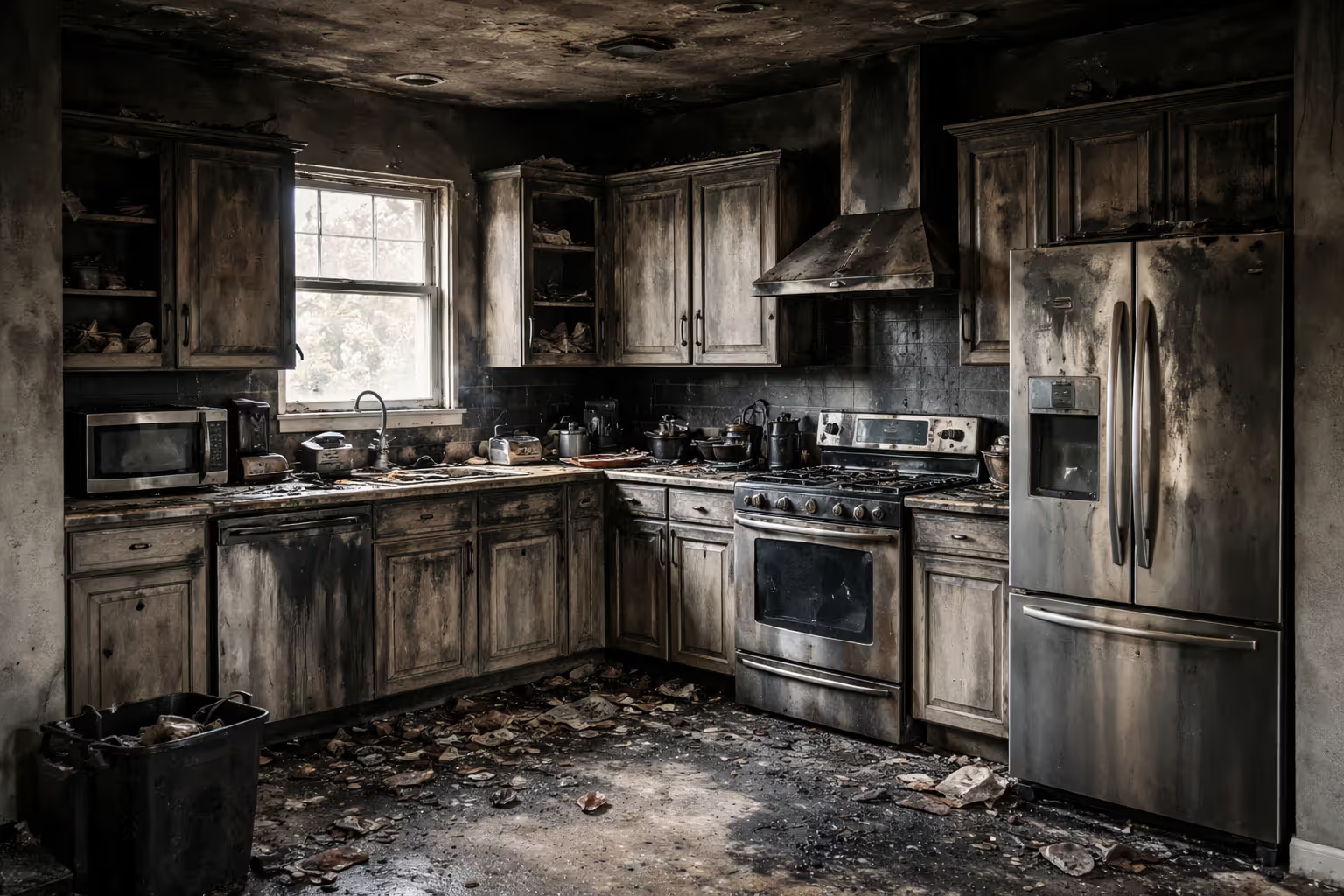
But let's say you've paid off your house completely. Do you still need coverage? Absolutely. Consider this scenario: A kitchen fire causes $185,000 in damage to your paid-off home. Without insurance, that bill comes straight from your savings account. For most Americans, that's a life-altering financial blow they'll never recover from.
Author: Trevor Whitfield;
Source: talero.spotpariz.net
The liability component matters just as much. Your neighbor trips over a garden hose in your yard and breaks her hip. She can't work for six months. Her attorney comes after you for medical bills, lost wages, and pain and suffering. We're talking potential settlements of $300,000 or more. Liability coverage handles both the legal defense and any settlement or judgment against you.
Some HOAs write insurance requirements directly into their governing documents. Skip coverage or let your policy lapse, and you're facing fines or even forced-placement insurance—which typically costs three times what you'd pay on your own.
Steps to Get Homeowners Insurance
Assess Your Coverage Needs
Skip this step and you're basically guessing at how much protection you need. That's not a game you want to play with your biggest asset.
Start with replacement cost—what it would actually cost to rebuild your house today if it burned to the ground tomorrow. Notice I said "rebuild," not "what you paid for it." Your purchase price includes the land, landscaping, and location value. Replacement cost is pure construction expense.
Professional appraisers charge $300-$600 for this service and provide the most accurate numbers. Many insurers offer free calculators, though results vary widely. I recently ran the same 2,400-square-foot ranch through three different calculators and got estimates ranging from $285,000 to $425,000. That's a massive gap.
Geography matters enormously here. Building that same home costs $165 per square foot in Oklahoma but $310 per square foot in San Francisco. Custom features drive costs even higher—timber beaming, specialty tile work, or high-end fixtures can push you well above local averages.
Now inventory everything you own. And I mean everything. Walk through your home with your phone and video every room, every closet, every drawer. Open your cabinets. Your belongings are probably worth way more than you think. A modest three-bedroom home easily contains $75,000-$125,000 worth of stuff.
Policies typically cover possessions at 50-70% of your dwelling amount. Insure your house for $400,000 and you've got $200,000-$280,000 in contents coverage. Sounds like plenty until you factor in that jewelry has a $1,500 cap, computers are limited to $5,000, and your wife's engagement ring isn't covered at all without a rider.
Consider your lawsuit exposure too. Standard policies include $100,000 in liability protection. If you've got a pool, a dog, or significant assets, that's laughably inadequate. Jump to $300,000 or $500,000 in coverage. An umbrella policy adding another $1-2 million costs less than you'd think—often under $400 yearly.
Shop and Compare Insurance Quotes
Getting just one quote is like buying the first car you see on the lot. You might luck into a great deal, but probably not.
Pull quotes from at least four companies. I've seen identical coverage priced at $1,850 from one carrier and $2,975 from another. Same house, same limits, same deductible. That's $1,125 in annual savings just for spending an extra hour comparing.

Author: Trevor Whitfield;
Source: talero.spotpariz.net
Hit the big national players first—State Farm, Allstate, Liberty Mutual, Nationwide. Then check regional carriers strong in your state. In Texas, look at Texas Farm Bureau and OPIC. Florida residents should price Citizens and Heritage. These regional companies often beat national pricing by 20-30% in their home markets.
Independent agents save you legwork. They represent 8-15 different insurance companies and can quote multiple carriers from one application. Captive agents work for one company but sometimes access proprietary discounts unavailable elsewhere.
Online tools have gotten pretty sophisticated. Plug in your information and receive 4-6 quotes in under ten minutes. Just remember—those initial numbers are estimates. Final pricing comes after the insurer pulls your claims history, runs your credit, and reviews property details.
Here's the mistake everyone makes: comparing quotes with different deductibles and coverage types. One quote has a $1,000 deductible with replacement cost coverage. Another shows $2,500 deductible with actual cash value settlement. Of course the second one's cheaper—it's also far less valuable. Standardize your comparison or you're comparing apples to tennis balls.
Ask specifically about discounts. Bundling home and auto with one carrier typically saves 18-25%. New roofs, security systems, and claims-free history unlock additional savings. I recently helped a client stack seven different discounts and cut her premium from $2,240 to $1,465. Same coverage, 35% less money.
Review Policy Terms and Coverage Limits
You've got your quotes. Now comes the part where most people's eyes glaze over: actually reading the policy documents.
The declarations page summarizes everything—your coverage limits, deductible, premium, and policy period. This is the one-page snapshot of your protection. The actual policy document runs 40-60 pages of definitions, exclusions, conditions, and procedures. Riveting stuff, right?
But here's what you're looking for: sublimits and coverage extensions. Your policy might show $125,000 in personal property coverage, but jewelry's capped at $1,500 unless you schedule it separately. Cash has a $200 limit. Firearms top out at $2,500. Business equipment used from home? Often completely excluded.
Water damage gets tricky fast. Your policy covers a burst pipe flooding your basement. It doesn't cover water backing up through your sewer line—that requires a separate endorsement costing $40-$125 yearly. Ground water seeping through your foundation? Also excluded. You need flood insurance for that, which we'll address shortly.
Check your loss settlement method. Replacement cost pays to replace your damaged 7-year-old refrigerator with a new equivalent model. Actual cash value gives you what that 7-year-old fridge was worth—maybe 40% of replacement cost after depreciation. A $1,500 refrigerator becomes a $600 check. Multiply that across every damaged item and you see why ACV policies are almost never worth the premium savings.
Standard policies exclude flood and earthquake damage completely. Live anywhere near water? The 100-year flood plain expanded significantly in recent years. Areas that never flooded before are now high-risk zones. Federal flood policies through NFIP max out at $250,000 for the structure and $100,000 for contents. Private flood insurance often provides higher limits at competitive pricing.

Author: Trevor Whitfield;
Source: talero.spotpariz.net
Earthquake coverage requires a specific endorsement in California, Oregon, Washington, and other seismically active states. Deductibles run 10-25% of your dwelling coverage—on a $500,000 home, you're paying the first $50,000-$125,000 of damage yourself.
Complete the Application Process
Time to fill out paperwork. Insurers ask detailed questions about your property's age, construction materials, roof condition, electrical system, heating type, and any updates or renovations.
They'll want your claims history going back 5-7 years. Filed three claims in the past five years? Expect significantly higher premiums or outright denials. Insurers share this data through CLUE (Comprehensive Loss Underwriting Exchange). Don't bother lying—they'll find out, and misrepresentation voids your coverage entirely.
Credit scores factor heavily into pricing. Insurers use specialized "insurance scores" that correlate with claims likelihood. Jump from fair credit (650) to excellent credit (780) and you might save 30-40% on identical coverage. Some states limit credit-based pricing, but it remains a dominant factor in most of the country.
Older homes often require inspections before insurers will bind coverage. They're checking for knob-and-tube wiring, outdated electrical panels, old roofs, foundation issues, and other risk factors. Expect required repairs as a coverage condition. That inspection finding a 25-year-old roof might trigger a requirement for replacement within 90 days or automatic policy cancellation.
Finalize Your Policy and Payment
Approval comes with a binder—temporary proof of insurance valid 30-60 days while formal documents get prepared. Your lender needs this binder at closing. Without it, funding gets delayed.
Choose your payment structure carefully. Annual payment saves 5-12% compared to monthly installments through most carriers. Some offer small discounts (3-5%) for automatic bank drafts. If you're financing the home, your lender probably requires escrow—they collect 1/12 of your annual premium each month as part of your mortgage payment, then pay the insurer directly when your policy renews.
Read your final policy when it arrives. Verify every detail matches your quote—coverage limits, deductibles, endorsements, and discounts. Mistakes happen. I caught an error last month where a client's wind/hail deductible jumped from 1% to 5% between quote and final policy. That's a $12,000 difference in out-of-pocket costs after a storm.
Policies renew annually. Your premium will adjust based on claims activity, inflation, coverage changes, and even your credit score fluctuations. Don't assume your rate stays locked.
Understanding Homeowners Insurance Coverage
Standard policies break protection into six distinct coverage sections, each addressing different loss types.
Coverage A: Dwelling handles the physical structure—your house and anything permanently attached like built-in appliances or a connected garage. Fire destroys your home and dwelling coverage pays to reconstruct it. This should match your full replacement cost, which we discussed earlier.
Coverage B: Other Structures protects detached buildings on your property. Sheds, standalone garages, fences, and gazebos fall here. Default coverage equals 10% of your dwelling amount. Insure your house for $350,000 and you've got $35,000 for other structures. Building a $75,000 detached workshop? You'll need to increase this limit.
Coverage C: Personal Property insures everything you own that isn't nailed down. Furniture, electronics, clothes, kitchen items, tools, sporting equipment—it all falls under personal property. Most policies set this at 50-70% of dwelling coverage. A $300,000 dwelling comes with $150,000-$210,000 in contents protection.
Coverage follows your belongings off-property too. Your laptop gets stolen from your car? Personal property coverage applies. Your luggage disappears during a flight? Same deal, subject to your deductible.
Coverage D: Loss of Use reimburses additional living expenses when covered damage makes your home unlivable. Your kitchen fire means you're living in a hotel for three months while contractors repair the damage. This coverage pays your hotel bills, restaurant meals, and other costs exceeding your normal living expenses. Typically set at 20-30% of dwelling coverage.
Coverage E: Personal Liability protects you when someone gets injured on your property or you accidentally damage someone else's property. Your dinner guest trips over your dog and breaks an arm. Legal fees and settlement costs come from liability coverage. Standard policies start at $100,000, though I strongly recommend $300,000-$500,000 minimum.
Coverage F: Medical Payments handles minor medical expenses for injured guests regardless of fault. Someone sprains an ankle on your stairs and needs an ER visit? Medical payments coverage handles the bill up to your limit (usually $1,000-$5,000) without requiring a lawsuit. This often prevents small injuries from becoming major liability claims.
How Homeowners Insurance Deductibles Work
Your deductible represents the portion you're personally responsible for before insurance kicks in. Storm damage totals $8,500 and you've got a $1,500 deductible? You pay $1,500, insurance pays $7,000.
Higher deductibles mean lower premiums—it's a direct trade-off. Move from $500 to $1,000 and watch your premium drop 12-18%. Jump to $2,500 and you're saving 25-35% on annual costs. A policy costing $2,100 yearly with a $1,000 deductible might drop to $1,470 with a $2,500 deductible. That's $630 in annual savings.
Sounds great until you need to file a claim and suddenly you're scrambling to find $2,500 cash to pay the contractor before work begins.
Most policies use flat dollar deductibles—$500, $1,000, $2,000, $2,500, or $5,000 per claim. You'll also encounter percentage deductibles, particularly for hurricane and hail damage in coastal areas. A 2% hurricane deductible on a home insured for $400,000 means you're responsible for the first $8,000 of storm damage. That can sting.
Some policies incorporate split deductibles with different amounts for different perils. Your standard deductible sits at $1,000 for fire, theft, and most claims. But you've got a 5% wind/hail deductible and a 2% hurricane deductible. Know these distinctions before disaster strikes or you're in for an ugly surprise.
Financial advisors typically suggest setting your deductible at the maximum amount you could comfortably cover from savings without serious financial strain. Sitting on $15,000 in emergency funds? A $2,500 or even $5,000 deductible makes sense. Living paycheck to paycheck with $2,000 saved? Stick with a $500 or $1,000 deductible despite the higher premium.
Coverage Limits and How to Set Them
Getting your coverage limits right makes the difference between recovering from disaster and facing financial ruin.
Dwelling coverage needs to match what rebuilding your home would actually cost right now. Not what you paid five years ago. Not what Zillow says it's worth. The actual construction expense using today's material costs and labor rates.
Market value includes your land—which can't burn down or blow away. Replacement cost is pure construction math. You might've paid $425,000 for your home in a great neighborhood, but the structure itself would cost only $315,000 to rebuild. Or vice versa—you paid $280,000 in a modest area, but custom features and high-end materials push replacement cost to $390,000.
Many carriers now offer extended replacement cost coverage paying 125-150% of your dwelling limit if construction costs spike unexpectedly. You're insured for $300,000, but inflation and material shortages push actual rebuild to $375,000. Extended replacement cost at 125% covers the full amount. This endorsement typically adds 5-12% to your premium.
Guaranteed replacement cost—which pays whatever reconstruction actually costs regardless of your limit—has mostly disappeared after insurers took massive losses in the 2000s. A handful of companies still offer it for newer homes in excellent condition.
Personal property limits automatically set at 50-70% of dwelling coverage, but that's not gospel. Own a lot of expensive furniture, electronics, collectibles, or designer clothing? Increase this limit. Don't assume your $4,500 living room set, $3,200 bedroom suite, and $2,800 in electronics all fall under standard coverage without checking sublimits.
Remember those category caps: $200 for cash, $1,500 for jewelry and watches, $2,500 for firearms, $2,500 for silverware, $2,500 for business property. Your daughter's class ring, wife's engagement diamond, and your watch collection could easily exceed $15,000, but you're only covered for $1,500 total without scheduling them separately.
Liability limits should roughly match your total assets and future earning potential. Worth $650,000 between home equity, retirement accounts, and savings? Carry at least $500,000 in liability coverage, preferably more. High-net-worth individuals need umbrella policies providing $1-5 million in additional protection. These cost surprisingly little—often $200-$500 annually for the first million.
Consider inflation guard endorsements that automatically bump your coverage limits 3-5% annually based on construction cost indices. This prevents gradual erosion of your protection as building expenses increase faster than you remember to call your agent.
Filing a Homeowners Insurance Claim
Knowing how claims work before you need to file one reduces stress and speeds up the process when you're already dealing with damage and disruption.
Step 1: Document everything immediately. Grab your phone and photograph or video every single bit of damage from multiple angles. Capture wide shots showing overall damage and close-ups highlighting specific issues. List every damaged or destroyed item you can identify, noting approximate age and what you paid for it. This documentation becomes crucial if disputes arise later about damage extent or item values.

Author: Trevor Whitfield;
Source: talero.spotpariz.net
Step 2: Contact your insurer fast. Call your agent, use the company's 24/7 claims hotline, or file online through their portal. Most policies require "prompt" notification—which means as soon as reasonably possible after discovering damage. You'll get a claim number and adjuster assignment within 24-48 hours typically.
Step 3: Prevent additional damage. Policies obligate you to protect your property from further harm when you reasonably can. Tarp that hole in your roof. Board up broken windows. Shut off water if pipes burst. Save all receipts—insurers reimburse reasonable emergency mitigation costs even if they exceed your coverage limits.
Step 4: Meet your adjuster. The insurance company sends someone to inspect damage and estimate repair costs. Be there during this inspection. Point out everything damaged—it's easy for adjusters to miss items. Answer questions honestly and thoroughly. The adjuster prepares a report determining your initial payment.
Step 5: Review the settlement offer carefully. Insurers send a settlement based on the adjuster's findings and your policy terms. This first check often covers immediately obvious damage, with additional payments coming as repairs progress or contractors discover hidden issues. Read the settlement letter completely. Understand what's covered, what's excluded, and why.
Step 6: Complete repairs and submit documentation. Hire licensed, insured contractors to do the work. Save every invoice, receipt, and change order. For replacement cost policies, insurers typically pay actual cash value first (replacement cost minus depreciation), then send the depreciation holdback once you prove you've completed repairs and replaced damaged items.
Simple claims resolve in 2-4 weeks. Major losses requiring extensive reconstruction can drag on 6-12 months or longer. Document every conversation with your adjuster, contractor, and insurer. If you're unsatisfied with the settlement offer, hire a public adjuster to represent your interests (they take 10-15% of your settlement) or request independent appraisal per your policy terms.
Common Mistakes When Getting Homeowners Insurance
Homeowners Insurance Policy Types Comparison
| Policy Type | What's Covered | Who Needs It | Important Details |
| HO-1 (Basic) | Ten specifically named perils only | Almost nobody—rarely sold anymore | Covers fire, lightning, windstorm, hail, explosion, riots, aircraft damage, vehicle damage, smoke, vandalism, and theft. Extremely limited protection. |
| HO-2 (Broad) | Sixteen named perils | Older homes; buyers on tight budgets | Adds weight of snow/ice, freezing, water damage from plumbing or appliances, electrical surges, falling objects, plus additional specific perils. Still limited compared to HO-3. |
| HO-3 (Special) | All perils except those specifically excluded (dwelling); named perils for contents | Most common—standard for single-family homes | Broadest protection for your house structure. Personal property covered for named perils only unless you upgrade. Best value for most homeowners. |
| HO-5 (Comprehensive) | All-risk coverage for both structure and belongings | Luxury homes; people with expensive possessions | Fewest exclusions. Covers both dwelling and contents on an open-perils basis. Costs 10-25% more than HO-3 but provides significantly better protection. |
| HO-8 (Modified) | Named perils; pays for functional repairs rather than full replacement | Historic homes; properties where rebuild costs far exceed market value | Designed for older homes with ornate features that would be prohibitively expensive to replicate exactly. Pays for equivalent functionality rather than exact replacement. |
Underinsuring to shave a few bucks off premiums represents the single costliest error homeowners make. Insure your $375,000 replacement cost home for only $275,000 and you're $100,000 short after a total loss. Worse, coinsurance clauses in most policies require you to insure for at least 80% of replacement value or the insurer reduces all claim payments proportionally.
Here's how that works: Your home needs $400,000 in coverage but you only carry $280,000 (70% of needed amount). File a $50,000 claim and the insurer pays only 87.5% because you're underinsured—you get $43,750 instead of $50,000 minus your deductible.
Accepting the first quote without shopping around costs the average homeowner $600-$1,200 annually in unnecessary premiums. I've compared quotes for the same property and seen pricing differences of $1,500 per year. That's real money you're leaving on the table by not spending two hours requesting competing bids.
Missing available discounts because you don't ask about them leaves savings unclaimed. Insurers won't automatically apply every discount you qualify for—you've got to inquire. Installing monitored security saves 10-20%. Impact-resistant roofing cuts another 15-30% in wind-prone areas. Bundling policies saves 15-25%. Combine multiple discounts and you're potentially cutting premiums in half.
Ignoring what's actually excluded sets you up for devastating disappointment after losses you thought were covered. Homeowners in river valleys assume flood coverage is automatic. It's not—you need separate flood insurance through NFIP or private carriers. Same goes for earthquakes, sewage backups, and various other perils buried in the exclusions section most people never read.
Forgetting to notify your insurer about major changes leaves improvements unprotected. Added a $65,000 primary suite addition? Built a $40,000 pool? Started a home-based business? None of these are covered until you formally notify your carrier and adjust your coverage. Many people discover this gap only after filing a claim that gets denied.
Choosing actual cash value settlement to save $200 yearly backfires spectacularly when you file claims. The depreciation deduction on a $30,000 claim might be $12,000. You saved $200 annually on premiums but lost $12,000 on your claim settlement. Replacement cost coverage is almost always worth the modest premium increase.
I've reviewed hundreds of homeowners policies over my 23-year career, and the pattern is always the same.People spend months researching which house to buy, weeks debating paint colors, but approximately 45 minutes selecting insurance coverage that protects their entire investment. Then they're shocked when a claim reveals massive gaps in protection. I had a client last year who saved $340 annually by choosing actual cash value coverage instead of replacement cost. After a kitchen fire caused $42,000 in damage, depreciation deductions left her $16,800 short of full recovery. That's a lesson nobody wants to learn the expensive way. My advice is simple: insure for complete replacement cost, carry liability coverage equal to your net worth, maintain six months of expenses in savings to handle your deductible, and review your policy every single year as your situation evolves
— Robert Chen
Frequently Asked Questions
Getting solid homeowners insurance protection doesn't happen by accident. It requires understanding what you're buying, knowing what you actually need, comparing real options from multiple carriers, and making informed decisions rather than just accepting whatever sounds cheapest.
Your policy isn't something you set up once and forget about. Life changes. You renovate. You accumulate more possessions. Construction costs increase. Your coverage should evolve with these changes, which means reviewing your policy annually and adjusting limits as needed.
The few hours you invest learning about coverage types, comparing quotes intelligently, and selecting appropriate limits will pay off for years—both in premium savings and, more importantly, in complete protection when something goes wrong. Your home represents your largest investment and often your family's greatest source of financial security. Protecting it properly is one of the smartest financial decisions you'll make.
Don't treat insurance as just another closing requirement or monthly bill. Treat it as the financial foundation that lets you sleep soundly knowing that whatever disasters come your way, you've got the resources to recover and rebuild without losing everything you've worked for.