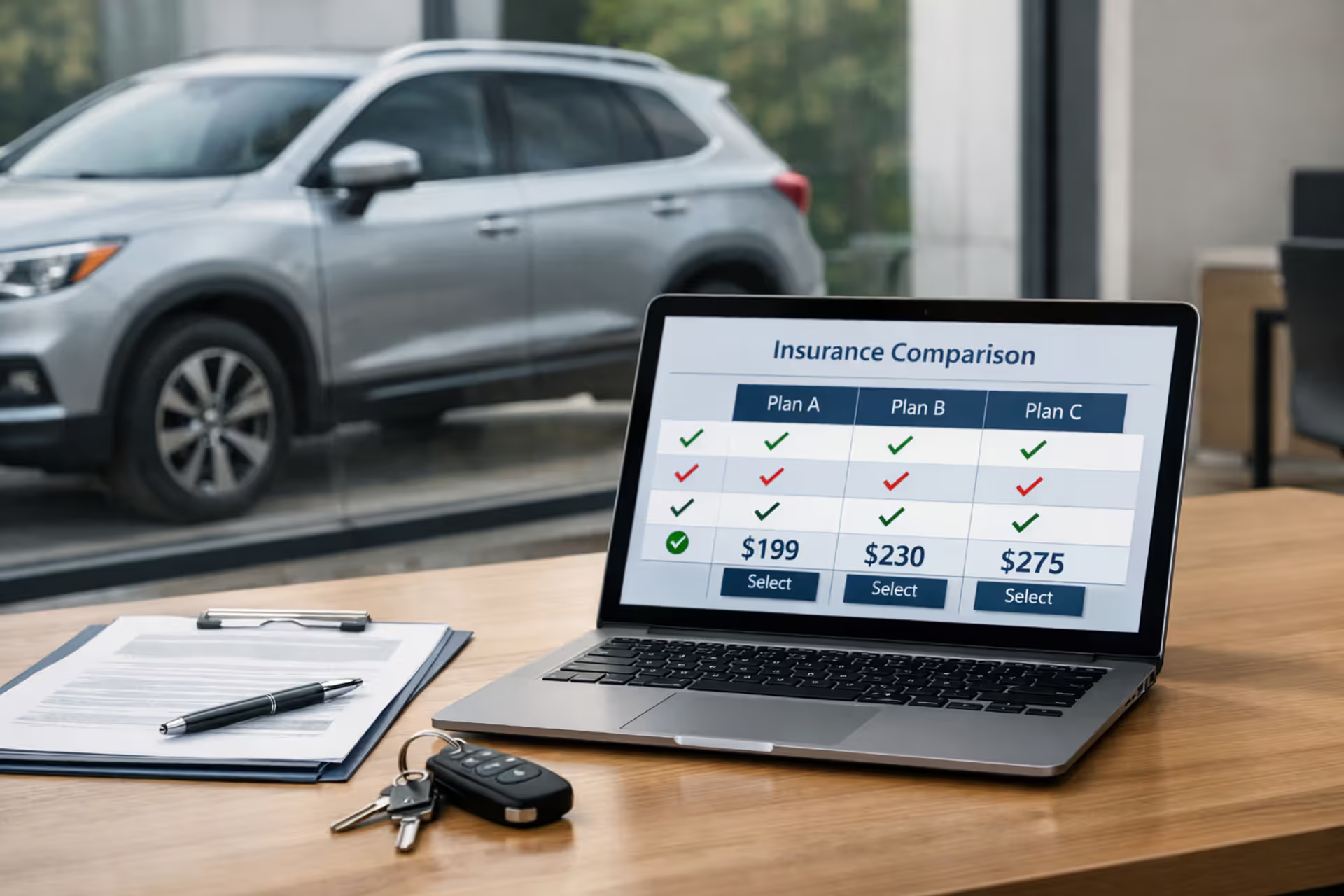
Car insurance quotes being compared on a laptop next to a car key and documents
How Much Is Car Insurance in the US?

Content
If you've recently shopped for car insurance, you've probably noticed quotes that seem all over the map. One company offers you $1,200 annually while another wants $3,500 for what appears to be identical coverage. This isn't random—it reflects how differently insurers evaluate risk and price their policies.
Most Americans with comprehensive protection spend somewhere between $1,400 and $2,200 each year, though that range barely scratches the surface of what people actually pay. Your neighbor might fork over $900 while you're stuck with a $4,000 bill, even if you both drive similar vehicles and have clean records. The difference often comes down to factors you'd never guess matter: your credit score, your job, even your level of education.
Where you live creates the biggest price swings. A 25-year-old with zero accidents in rural Iowa might enjoy $900 annual premiums, while an identical driver in Detroit's city center could see $4,500 on their renewal notice. Insurance companies aren't picking numbers out of thin air—they're crunching actuarial tables filled with local accident data, theft reports, lawsuit trends, and weather damage claims specific to your area.
What most people don't realize? You control more of this equation than you think. Sure, you can't change your birthday or instantly relocate, but smart choices about what coverage you actually need, how much you're willing to pay upfront when things go wrong, and which discounts you qualify for can slash your bill by anywhere from one-fifth to nearly half. First, though, you need to understand what makes that number climb in the first place.
Average Car Insurance Costs by State
Your home state shapes your insurance bill more than almost any other single factor. Each state sets its own minimum coverage requirements, faces unique weather risks, and deals with different levels of uninsured drivers on the road—all of which directly impact what insurers charge.

Author: Trevor Whitfield;
Source: talero.spotpariz.net
Take a look at how full coverage premiums stack up across different parts of the country:
| State | Typical Yearly Cost | Difference from US Average |
| Louisiana | $3,652 | 84% higher |
| Florida | $3,183 | 60% higher |
| Michigan | $2,989 | 50% higher |
| Nevada | $2,841 | 43% higher |
| California | $2,551 | 28% higher |
| United States (average) | $1,995 | baseline |
| Texas | $2,148 | 8% higher |
| Illinois | $1,876 | 6% lower |
| Ohio | $1,543 | 23% lower |
| Wisconsin | $1,387 | 30% lower |
| Iowa | $1,298 | 35% lower |
| Vermont | $1,245 | 38% lower |
| Maine | $1,156 | 42% lower |
Louisiana holds the dubious honor of America's priciest car insurance market. About 12% of Louisiana drivers operate without any coverage at all (they'll flee the scene or you'll be stuck chasing someone who can't pay). Add in regular hurricane damage, flood losses, and courts that routinely award six-figure injury settlements, and you've got a perfect storm of expensive insurance.
Michigan used to be even worse before recent reforms. The state's unique no-fault system—where your insurance pays your medical bills regardless of who caused the crash—combined with Detroit's urban density keeps prices elevated despite improvements.
Meanwhile, drivers in Maine and Vermont enjoy some of the country's lowest rates. Fewer cars on the road means fewer accidents. Rural highways don't produce the constant fender-benders you see in Los Angeles gridlock. The driving culture in New England tends toward caution rather than speed. Insurers reward all of this with premiums running 30-50% below what urban drivers pay.
Even within a single state, moving from a city to suburbs often cuts your premium by a third. State minimum requirements matter too—New Hampshire doesn't mandate coverage at all (though you're still liable for damages), while Alaska requires $50,000 in bodily injury protection per person, double what many states demand.

Author: Trevor Whitfield;
Source: talero.spotpariz.net
What Affects Your Car Insurance Rate
Insurance companies feed dozens of data points into their pricing algorithms, but they generally evaluate three main categories: your personal profile as a driver, the vehicle you're insuring, and the protection level you're purchasing.
Driver-Related Factors
Your individual characteristics account for roughly 60% of what you'll pay. Age hits hardest—teenage drivers and those in their early twenties pay an extra $2,800 annually compared to 40-year-olds buying identical coverage. Why? Statistics show younger drivers crash more often. The premium drops sharply once you hit 25, stays relatively flat through middle age, then creeps back up after 70 as reaction times slow and accident rates tick upward again.
Your driving history creates an even bigger impact. Cause one accident and expect your bill to jump 20-40% for the next three to five years. Get convicted of DUI? Your rates might triple, or you might find yourself completely uninsurable through standard companies, forced into high-risk pools where annual costs can breach $6,000. Even speeding tickets sting—each violation adds 10-25% to your premium for three years.
Credit scores influence rates in 47 states (California, Hawaii, and Massachusetts forbid this practice). Someone with excellent credit might pay 50-70% less than a person with poor credit, even if everything else about them is identical. Insurance companies insist credit correlates strongly with how often people file claims. Consumer advocates argue there's no fair reason financial history should affect driving costs, but for now, it does.
Your marital status makes a difference too—married couples average 10% savings compared to single drivers. Your job matters: teachers, engineers, and scientists often qualify for occupational discounts, while food delivery drivers or Uber operators face surcharges or outright coverage exclusions.
Vehicle-Related Factors
Author: Trevor Whitfield;
Source: talero.spotpariz.net
The car sitting in your driveway determines what you'll pay for collision and comprehensive protection. Insurers consider several vehicle characteristics:
Repair expenses: Luxury brands with expensive parts cost more to insure. Fixing a damaged Honda Civic might require $800 in annual collision coverage, while an equivalent policy for a BMW 5 Series could demand $2,200.
Theft vulnerability: Models that car thieves target frequently—like Dodge Chargers, certain Kia Souls (especially pre-2023 models), and popular Honda Accords—carry higher comprehensive premiums because insurers expect to pay theft claims.
Safety technology: Vehicles equipped with automatic emergency braking, lane-keeping assistance, and blind-spot monitoring earn discounts of 5-15%. Cars that crumple badly in crash tests face surcharges instead.
Repair complexity: Modern vehicles with aluminum construction, calibrated sensor arrays, or integrated tech systems cost dramatically more to fix after even minor accidents. A $2,000 fender-bender on a Toyota Camry might run $5,000 on a Tesla Model 3 because of all the sensors that need recalibration.
How much you drive annually affects pricing too. Log only 5,000 miles per year? You'll probably pay 15-20% less than someone driving 15,000 miles, simply because you're on the road—and at risk of accidents—less often.
Coverage Choices and Deductibles
The protection you select directly controls your final bill. Bare-bones liability coverage meeting your state's minimum might cost just $450 yearly, while a robust policy with high limits and comprehensive protection runs $2,000 or more. Each coverage component adds its own expense:
- Liability coverage (paying for harm you cause others): $600-$1,200 annually if you select 100/300/100 limits
- Collision coverage (fixing your car after crashes): $400-$1,500 depending on your vehicle's value and your chosen deductible
- Comprehensive coverage (handling theft, weather damage, vandalism): $200-$600 for typical vehicles
- Uninsured/underinsured motorist protection: $100-$300
- Medical payments or personal injury coverage: $50-$400
Raising your deductible from $250 to $1,000 typically slashes your collision and comprehensive costs by 30-40%, but you'll need to cover more expenses yourself when filing a claim.
Types of Car Insurance Coverage and What They Cost
Understanding what each coverage component actually protects helps you decide where to invest your insurance budget and where you might be overpaying for protection you don't need.
Liability coverage is required in nearly every state. This pays when you injure someone or damage their property in an accident. Bodily injury liability runs about $0.60-$1.20 per $1,000 of protection annually. Property damage liability costs roughly $0.40-$0.80 per $1,000. So a policy covering up to $100,000 per injured person, $300,000 per accident, and $100,000 for property damage typically costs $700-$1,100 per year.
Many states set dangerously low minimums—often just 25/50/25. That won't come close to covering serious accidents. A multi-vehicle collision with injuries can easily generate $200,000 in claims against you. Umbrella policies (starting around $200 annually for an extra $1 million in coverage) provide crucial protection beyond your auto policy's limits.
Collision coverage fixes your vehicle after accidents, regardless of who's at fault. Most cars require $450-$1,400 annually for this protection, varying with your vehicle's value and your selected deductible. This coverage makes financial sense while your car is worth several thousand dollars, but becomes wasteful as vehicles age. Consider this: if your car is worth $4,000, collision coverage costs $800 annually, and you've chosen a $1,000 deductible, you're paying too much to protect too little.
Comprehensive coverage steps in when your car suffers damage from non-crash events: someone steals it, vandals key the paint, hail dents the roof, flooding soaks the interior, a deer jumps into your path, or a tree branch falls on your hood. Annual costs range from $180-$550 for typical vehicles. This protection becomes especially valuable in areas prone to severe weather or high theft rates. Like collision, it becomes less worthwhile as vehicles lose value.
Uninsured/underinsured motorist coverage (abbreviated UM/UIM) becomes your safety net when the driver who hits you either has no insurance or carries insufficient coverage to pay for your injuries and damages. Given that roughly 13% of American drivers operate without insurance nationally—and over 20% in states like Florida—this coverage provides essential protection. It costs $120-$300 annually and typically matches your liability limits. Skipping it is risky, especially in states with high uninsured driver rates.
Medical payments coverage (MedPay) or personal injury protection (PIP) covers medical expenses for you and passengers after accidents. MedPay typically costs $50-$150 annually for $5,000-$10,000 in coverage. PIP, mandated in no-fault states, runs more expensive ($200-$600) but covers broader expenses including lost wages and rehabilitation costs.
Rental reimbursement adds $30-$60 to your annual bill and provides rental cars while yours is being repaired after covered damage. Roadside assistance costs $15-$40 per year, though auto club memberships like AAA often deliver better value.
How Car Insurance Deductibles Work
Think of your deductible as your share of the repair bill before your insurance company contributes anything. Deductibles attach to collision and comprehensive coverage—your liability coverage doesn't have one.
Here's an example: you cause an accident that damages your car to the tune of $4,000. If you've selected a $500 collision deductible, you'll pay that $500 and your insurer covers the remaining $3,500. Had you chosen a $1,000 deductible instead, you'd pay the first $1,000 and insurance would cover $3,000.

Author: Trevor Whitfield;
Source: talero.spotpariz.net
The calculation is straightforward: accepting a higher deductible lowers your premium but increases your immediate costs when something goes wrong. Consider these typical numbers:
A driver selecting a $250 deductible might pay $1,200 annually for collision coverage. Bumping it to $500 could reduce that premium to $1,000. Jumping to a $1,000 deductible might drop it to $750. Over three years, the $1,000 deductible saves $1,350 in premiums compared to the $250 option—but each claim costs you $750 more out of pocket.
Which deductible makes sense for you? It depends on your emergency fund. If coming up with $1,000 tomorrow for unexpected car repairs would stress your finances, stick with a lower deductible despite higher premiums. If you've got solid emergency savings and a clean driving record, higher deductibles usually save money long-term.
Here's something many drivers miss: you can choose different deductibles for collision and comprehensive. Since comprehensive claims (for theft, hail damage, hitting a deer) typically don't raise your rates, you might select a lower comprehensive deductible ($250) while keeping collision high ($1,000). This provides affordable protection against unpredictable events while still saving on premiums.
Never select a deductible higher than your vehicle's current value. If your car is worth $5,000, a $1,000 deductible makes perfect sense, but a $2,500 deductible provides minimal additional savings while leaving you severely underinsured.
How to Lower Your Car Insurance Costs
Most Americans overpay for car insurance simply because they accept whatever number appears on their renewal notice without shopping around. Making strategic changes can trim your bill considerably.
Compare quotes regularly—at least once a year. Insurance companies constantly adjust their pricing models, and the cheapest option today won't be the cheapest option next year. Drivers who collect quotes from at least five different insurers typically save around $450 annually. Make sure you're requesting identical coverage limits from each company so you're comparing apples to apples.
Drivers who compare quotes from at least three insurers save an average of $400 per year. Staying loyal to one company rarely rewards you—insurers often nudge rates up gradually for existing customers while dangling better deals in front of new business
— Laura Adams
Bundle your policies together. Buying auto and homeowners (or renters) insurance from the same carrier typically cuts 15-25% from both policies. Even if the auto premium alone isn't the absolute lowest you can find, the combined discount often makes bundling the smarter financial move.
Dig into every available discount. Common ones include: - Accident-free driving record (no crashes or violations for 3-5 years): 10-25% off - Good student grades (maintaining a 3.0 GPA or higher): 8-15% off - Completing defensive driving courses: 5-10% off - Low annual mileage (under 7,500 miles): 5-15% off - Advanced safety equipment in your vehicle: 5-15% off - Paying your full premium upfront: 5-10% off - Going paperless and setting up autopay: 2-5% off
When you stack multiple discounts together, you can sometimes cut your premium by a third or more.
Work on improving your credit score. In states that allow credit-based pricing, boosting your score from fair to good territory can save $500-$800 each year. Simple steps help: pay every bill on time, chip away at credit card balances, and dispute any errors you find on your credit report.
Try usage-based insurance programs. These telematics programs track your driving through smartphone apps or devices that plug into your car. If you brake smoothly, avoid hard turns, and mostly drive during low-risk hours, you can save 10-30%. These programs work best for cautious drivers who don't rack up many miles.
Increase deductibles strategically. As covered earlier, jumping from a $250 deductible to $1,000 can slice 30-40% off your collision and comprehensive premiums. Just make sure you've got enough in your emergency fund to cover the higher out-of-pocket cost if you need to file a claim.
Remove collision and comprehensive from older vehicles. Once your car's value drops below $3,000-$4,000, you might be paying more over two years for collision and comprehensive coverage than the vehicle is worth. Keep your liability coverage (which is required and protects your assets), but consider dropping the rest.
Review your coverage limits every year. Maybe you bought a $40,000 car three years ago—it's probably worth around $24,000 now. Make sure your collision coverage reflects today's value, not what you paid originally. On the flip side, if your assets have grown (bought a house, built up savings), increase your liability limits to protect what you've accumulated.
Take a defensive driving course. Many states require insurers to offer discounts for completing approved courses. Even where it's optional, insurers often reward completion with 5-10% savings that last for three years.

Author: Trevor Whitfield;
Source: talero.spotpariz.net
Understanding the Car Insurance Claim Process
Knowing how to file a claim efficiently—and understanding the financial consequences—helps you make smarter decisions about when to use your insurance versus paying for minor repairs yourself.
Step 1: Handle the immediate situation. After an accident, check everyone for injuries first. Call 911 if anyone is hurt or if there's major property damage. Exchange information with other drivers: names, phone numbers, insurance details, license plate numbers. Photograph everything—vehicle damage from multiple angles, the position of all cars involved, the accident scene itself. Note weather conditions, traffic signals, and contact information for any witnesses.
Step 2: Contact your insurer quickly. Most policies require notification within 24-72 hours, even when you're clearly not at fault. Call your agent or the claims hotline. Stick to factual information—don't admit fault or speculate about what caused the accident. Your insurer assigns you a claim number and connects you with an adjuster.
Step 3: Keep detailed records. Document every conversation, medical treatment, repair estimate, and expense. If your car isn't drivable, ask about your towing coverage and rental car reimbursement. Don't green-light any repairs until the adjuster has inspected the damage or approved an estimate.
Step 4: Cooperate with the adjuster. The adjuster examines your vehicle, reviews the police report if one was filed, and determines what coverage applies. For accidents you caused, your collision coverage pays to fix your vehicle (after you pay your deductible). When you're not at fault, you can file through the other driver's insurance or use your own collision coverage while your insurer pursues subrogation to recover the costs.
Step 5: Evaluate the settlement offer. The adjuster provides a damage estimate. If you disagree with it, get independent repair quotes to support your position. For total losses (where repair costs exceed your vehicle's value), insurers pay actual cash value based on what comparable vehicles in your area are selling for. You can negotiate if their valuation seems too low—bring evidence from local car listings.
Step 6: Complete repairs and finalize the claim. Select a repair shop (you're not required to use the insurer's preferred network, though it might simplify the process). After repairs are done, inspect the work carefully before signing off. The claim closes once everyone agrees the work is satisfactory.
How claims impact future rates: Accidents where you're at fault typically boost your premiums by 20-50% for three to five years. The exact increase depends on the claim's total cost, your previous history, and your insurer's specific policies. A minor $1,500 fender-bender might add $300-$600 annually, while a serious $15,000 accident could add $1,000 or more.
Not-at-fault accidents generally shouldn't raise your rates, though some insurers apply small increases (5-10%) based on research suggesting that any accident—regardless of fault—indicates slightly elevated risk. Comprehensive claims for theft or weather damage usually don't affect rates unless you're filing multiple claims within a short period.
Should you file or pay yourself? You need to do the math. Let's say you've got $800 in damage and a $500 deductible. Insurance would only pay $300—but filing that claim might increase your premium by $400 annually for three years. You'd end up paying $1,200 in higher premiums to receive $300 in claim payment. For damage under $1,000-$1,500, paying out of pocket often makes better financial sense.

Author: Trevor Whitfield;
Source: talero.spotpariz.net
Frequently Asked Questions
Car insurance pricing reflects complex risk calculations, but you wield more influence over your premium than you probably realize. While certain factors stay beyond your control—you can't reverse your age or instantly move to a cheaper state—strategic decisions about coverage levels, deductibles, and discount opportunities can save you hundreds or even thousands of dollars each year.
The single most impactful action? Shop around consistently. Insurance companies constantly recalibrate their pricing models, and the best deal available keeps shifting. Drivers who regularly compare quotes and optimize their coverage pay dramatically less than those who simply accept whatever renewal notice arrives in the mail.
Grasping what actually drives your rate—and what protection each coverage type provides—empowers smarter decisions. Strike a balance between adequate protection and affordable premiums by selecting appropriate liability limits, strategic deductibles, and only the coverage that genuinely serves your needs. Make it a habit to review your policy annually as your life circumstances evolve, and don't hesitate to switch insurers when superior options surface.