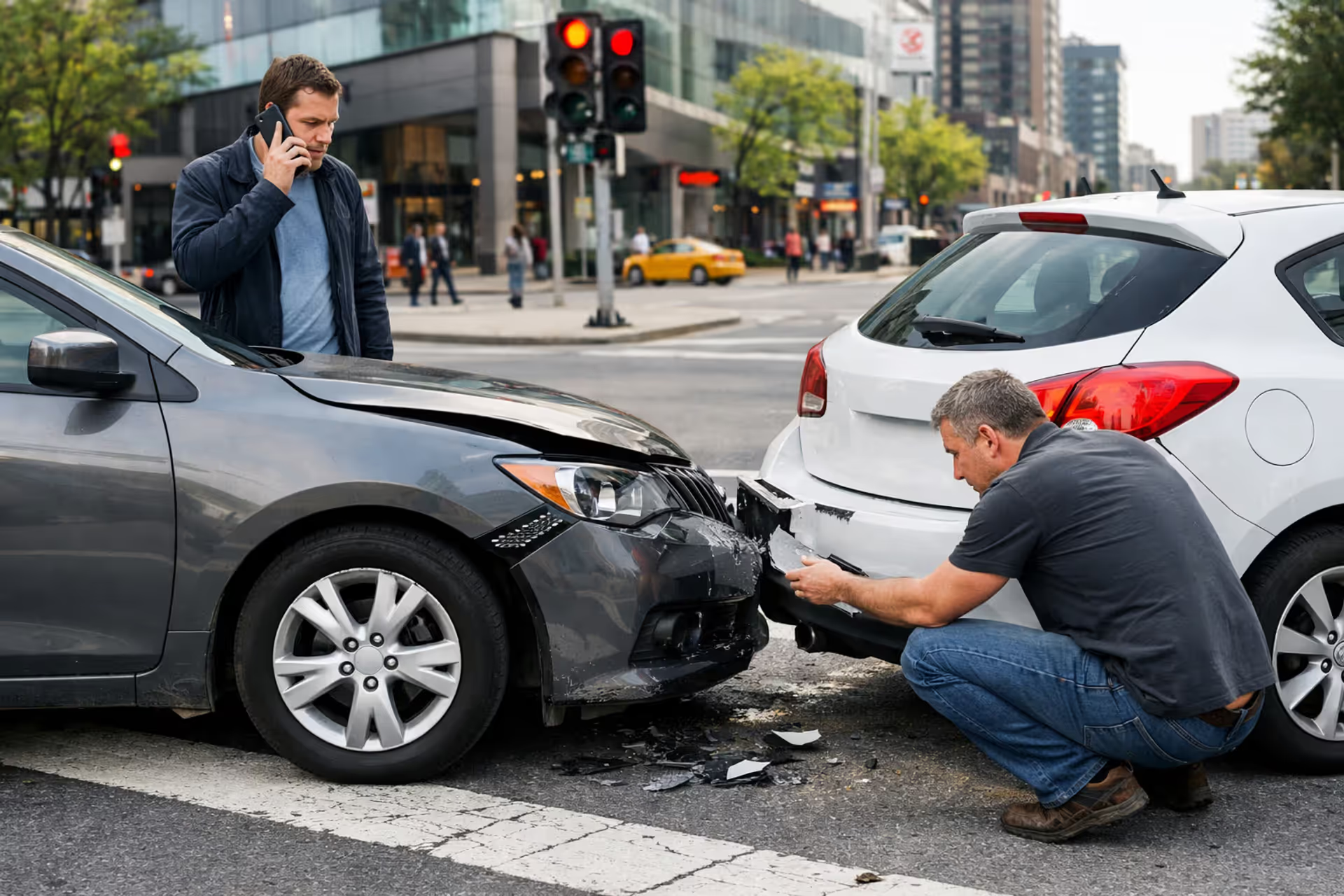
Car insurance concept with driver, vehicle and policy protection elements
How Does Car Insurance Work for Drivers in the US?

Content
You write a check every month to your insurance company. In return, they promise to step in when things go wrong—when you back into a mailbox, when someone rear-ends you at a stoplight, when hail dents your hood. Think of it as financial backup: instead of scrambling to find $8,000 after a fender-bender, you file a claim and let your insurer handle the bill (minus whatever deductible you agreed to).
Here's the basic exchange. Your monthly or six-month payment buys you protection against specific problems listed in your policy. Crash your car? Collision coverage kicks in. Windshield destroyed by a rock on the highway? That falls under comprehensive. Injure someone in an accident you caused? Liability coverage pays their medical bills and repairs their vehicle, up to the dollar amounts you selected when you bought the policy.
Nearly every state requires you to carry at least liability protection. Drive without it and you're risking fines, license suspension, and personal financial ruin if you cause a serious crash. The insurance industry operates on a simple principle: most people pay in more than they take out. Those premiums from thousands of careful drivers create a pool of money that covers the unlucky few who total their cars or cause major accidents each year.
What Car Insurance Is and Why It's Required
Think of car insurance as a legally binding promise. You agree to pay regular premiums. The insurance company agrees to cover certain losses detailed in your policy—crashes, theft, injury claims, property damage. Both sides sign a contract spelling out exactly what's covered, how much the insurer will pay, and what you'll pay out-of-pocket.
Every state except New Hampshire forces drivers to prove they can pay for damage they cause before letting them register a vehicle. In practice, that means buying liability coverage. The required amounts vary wildly. California wants $15,000 per person for injuries. Alaska demands $50,000. Maine sits at $50,000 too, while Florida only requires $10,000 for property damage and doesn't mandate bodily injury coverage at all unless you've been convicted of certain violations.
Why the mandate? Two reasons matter to lawmakers. First, innocent people deserve compensation when a careless driver hurts them or destroys their property. Second, uninsured drivers often can't pay, leaving hospitals, businesses, and other drivers stuck with bills. Emergency rooms treat crash victims regardless of insurance, and taxpayers end up covering those costs. State-required coverage shifts that burden back to drivers.
Still, meeting your state's minimum rarely gives you enough protection. Cause a three-car pileup with injuries and you could easily face $200,000 in claims. If you only carry $50,000 in coverage, you're personally liable for the remaining $150,000. Lawyers can pursue your savings, garnish wages, and place liens on your home. Skip insurance altogether and you'll face fines from $150 to $5,000 depending on your state, plus impoundment fees if police tow your car, and suspension of your license until you prove financial responsibility.
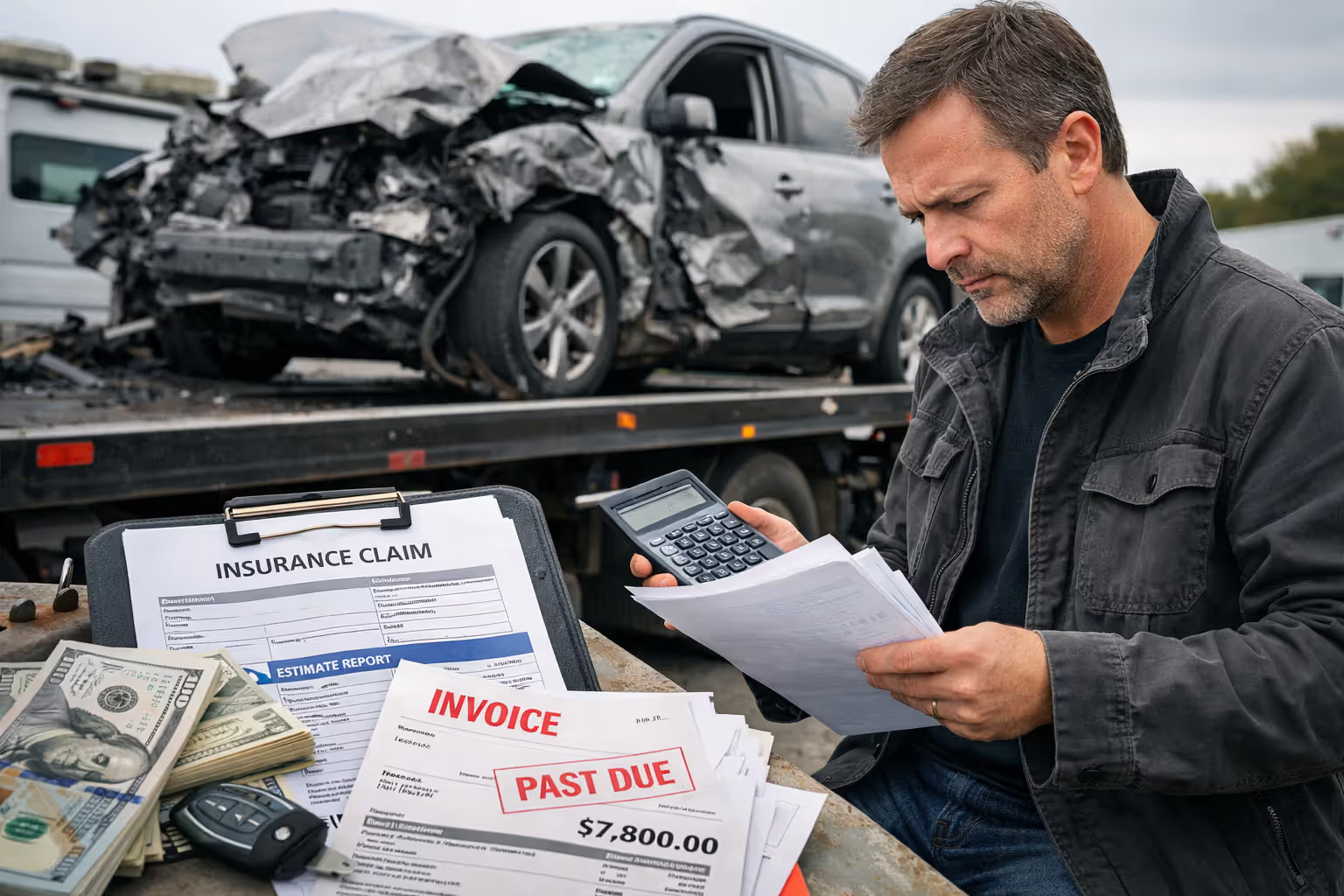
Beyond avoiding legal trouble, coverage protects you from life-altering financial hits. Total your $32,000 SUV with only liability insurance and you'll pay the full replacement cost yourself while continuing to make payments if you still owe on a loan.
Author: Alyssa Coleman;
Source: talero.spotpariz.net
How Car Insurance Premiums Are Calculated
Insurance companies employ actuaries—statisticians who predict risk—to calculate what you'll pay. They analyze millions of data points to estimate how likely you are to file a claim and how expensive that claim will probably be.
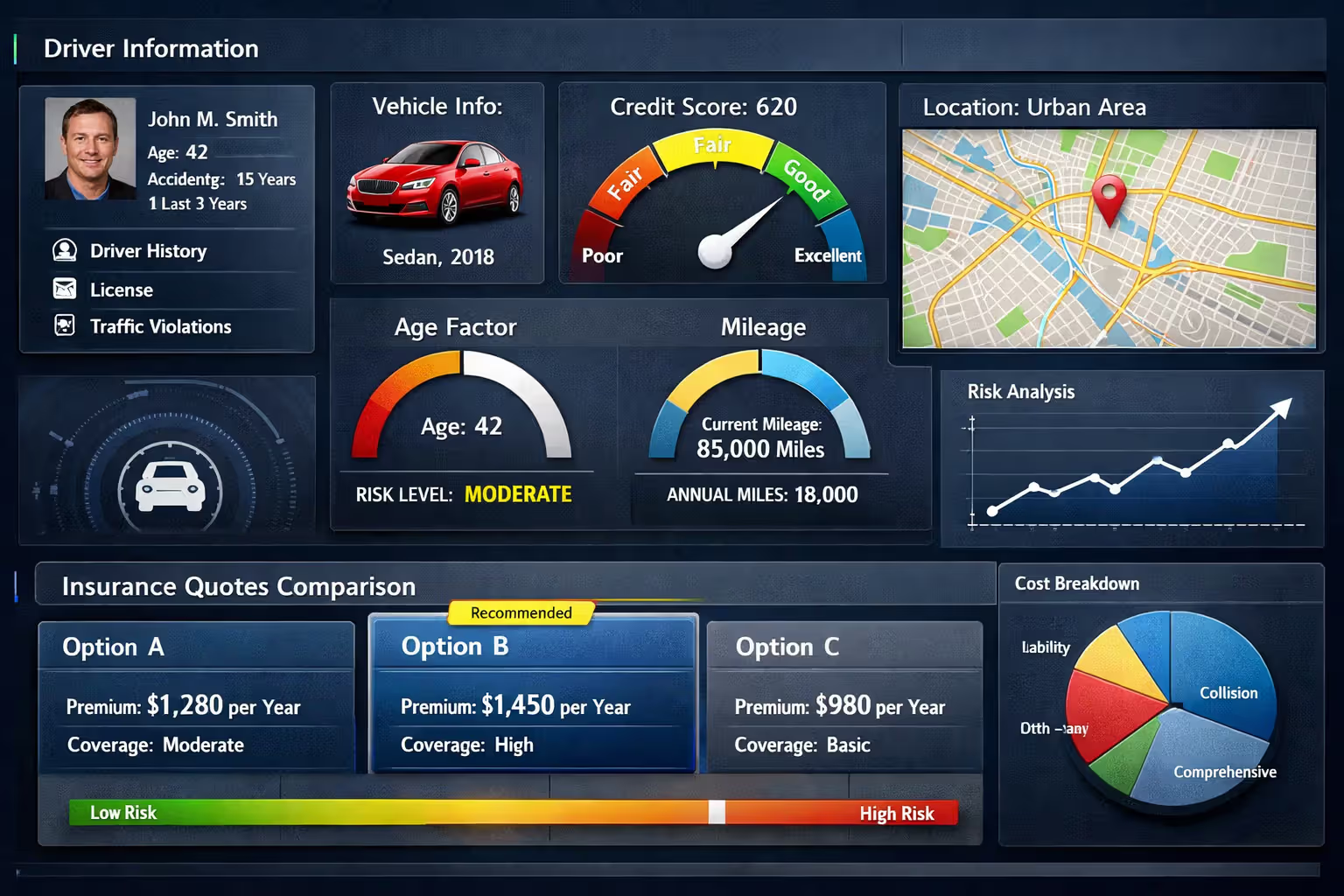
Your driving history carries the most weight. One at-fault accident typically bumps your rate 28–45% for the next three to five years. Get convicted of DUI and expect rates to triple, if you can find coverage at all. Many standard insurers refuse DUI drivers entirely, forcing them into high-risk assigned pools where annual premiums regularly hit $6,000–$10,000. On the flip side, go five years without any tickets or crashes and you'll qualify for accident-free discounts cutting your bill by 20% or more.
Age creates dramatic price swings. A 19-year-old male driver in Miami might pay $6,200 yearly for the same coverage that costs a 50-year-old woman $1,400. Why? Statistics don't lie: young drivers crash far more often than middle-aged ones. Rates generally drop as you gain experience through your 20s and 30s, bottom out between ages 50–65, then creep up again after 70 as reflexes slow and accident rates tick upward.
Where you live matters enormously—sometimes more than your driving record. Park your car in Detroit and you'll pay roughly four times what you'd pay in Burlington, Vermont for identical coverage. Dense urban areas mean more crashes, more theft, higher repair costs. State regulations play a role too. Michigan requires unlimited personal injury protection, creating the nation's steepest average premiums at $2,878 annually. Meanwhile, drivers in rural Maine enjoy averages around $965 thanks to less traffic and lower minimum coverage requirements.
Your actual vehicle influences your rate in obvious and subtle ways. Insurers look at repair costs, theft statistics, safety test results, and engine power. A 2019 Honda CR-V costs substantially less to insure than a 2019 Dodge Challenger because the CR-V costs less to fix, gets stolen less frequently, and doesn't tempt drivers to floor the accelerator. High-performance cars with 400+ horsepower trigger surcharges since they correlate with speeding tickets and expensive claims.
Most states allow insurers to check your credit and use the results to set rates. People with credit scores below 600 often pay double what someone with a 750+ score pays, even with identical driving records. Massachusetts, California, Hawaii, and Michigan have outlawed this practice, but elsewhere it's standard. Insurers claim lower credit scores correlate with more claims, though consumer advocates dispute whether credit actually predicts driving behavior.
Other factors creep into formulas: how many miles you drive annually, whether you're married (married people crash less statistically), your education level, your job, whether you own a home. Every company weighs these variables differently, which explains why identical drivers get quotes ranging from $1,200 to $4,800 from different insurers.
Author: Alyssa Coleman;
Source: talero.spotpariz.net
Understanding Coverage Types and What They Protect
Standard policies bundle several distinct protections. Each one covers different scenarios. Understanding what you're actually buying prevents nasty surprises when you file a claim.
Liability Coverage
This pays for harm you inflict on other people. Liability breaks into two buckets: bodily injury and property damage. The bodily injury portion covers medical treatment, lost paychecks, pain and suffering compensation, and legal defense if someone sues you after a crash you caused. Property damage pays to fix or replace vehicles, fences, mailboxes, storefronts—anything you damage that belongs to someone else.
Notice what liability doesn't cover: your own medical bills or vehicle repairs. It exclusively protects others from your mistakes. Nearly every state mandates it because society decided negligent drivers must compensate their victims. Rear-end someone who needs $40,000 in surgery but only carry $25,000 in bodily injury coverage? You're personally on the hook for $15,000, and the injured person's lawyer will pursue your assets until they collect.
Collision and Comprehensive Coverage
Collision pays to fix your vehicle after crashes, whether you caused the accident or not. Slide on black ice into a ditch? Collision handles it. Get T-boned by someone who ran a red light? Collision covers your repairs even if the other driver is at fault (though your insurer will then pursue their insurance company to recover costs).
Comprehensive handles everything else that can damage or destroy your car: theft, vandalism, fire, floods, hail damage, falling tree branches, hitting a deer. When your car gets stolen from a parking lot or a shopping cart dings your door, comprehensive takes care of it—minus your deductible.
Neither collision nor comprehensive is legally required, but any lender holding your auto loan will absolutely require both until you pay off the vehicle. Once you own the car free and clear, you can drop these coverages. Of course, that means paying the full replacement cost yourself if something happens.
Personal Injury Protection and Medical Payments
Personal Injury Protection (PIP) pays your own medical bills, lost income, and sometimes funeral expenses after a crash, regardless of who caused it. Twelve states—Florida, Hawaii, Kansas, Kentucky, Massachusetts, Michigan, Minnesota, New Jersey, New York, North Dakota, Pennsylvania, and Utah—require PIP as part of their "no-fault" systems. Instead of fighting over fault to determine whose insurance pays, everyone collects from their own policy for medical costs. PIP limits range from $10,000 in some states to unlimited coverage in Michigan.
Medical Payments coverage (MedPay) is simpler and available in fault-based states. It just covers medical and funeral bills for you and anyone in your car, typically capping at $5,000–$10,000. MedPay doesn't replace lost wages or provide other benefits. It works alongside your health insurance, sometimes covering deductibles and co-pays.
Uninsured/Underinsured Motorist Coverage
Uninsured Motorist protection pays your bills when someone without insurance causes a crash that injures you or damages your car. Underinsured Motorist coverage applies when the at-fault driver's policy limits don't cover your full damages. Say someone with bare-minimum $25,000 liability crashes into you, causing $90,000 in injuries. Their insurance pays their $25,000 maximum, then your Underinsured Motorist coverage can pay the remaining $65,000 (up to your policy's limits).
About one in eight American drivers operates without insurance despite state laws. In Mississippi and Michigan, that ratio reaches one in four. Roughly half of all states require UM/UIM coverage. Even where it's optional, it's usually cheap relative to the protection—often $50–150 yearly for $100,000 in coverage.

Author: Alyssa Coleman;
Source: talero.spotpariz.net
How Deductibles Affect Your Out-of-Pocket Costs
Your deductible is the chunk you pay before insurance takes over. Cause $4,100 in damage to your own car and carry a $750 collision deductible? You write a check for $750; your insurer covers the remaining $3,350. Deductibles apply each time you file a claim, not annually like health insurance.
Collision and comprehensive always include deductibles. You choose the amount when buying the policy, typically selecting anywhere from $250 to $2,000. Higher deductibles slash your premiums. Jump from a $250 deductible to $1,000 and you might cut your collision and comprehensive premiums by 30–40%. That's $300–600 in annual savings for many drivers.
The tradeoff seems obvious: lower premiums mean bigger bills when you file a claim. Say the $250 deductible costs you $180 more per year than the $1,000 option. You go four years without a claim. You've spent an extra $720 to avoid paying an additional $750 if something bad happens—basically a wash, except you haven't needed the coverage. But if you can't comfortably produce $1,000 on short notice, that higher premium buys financial predictability.
Liability coverage typically has no deductible. If you injure someone and owe $85,000, your insurer pays the full amount up to your policy maximum. Some policies attach deductibles to Uninsured Motorist claims, though rules vary by state.
One mistake costs drivers thousands: filing small claims barely above the deductible. Imagine $900 in damage with a $500 deductible. You get $400 from insurance but may trigger rate increases costing $25–50 monthly for three years—$900 to $1,800 total. Savvy drivers reserve insurance for major losses and self-fund minor repairs.
Coverage Limits and Policy Maximums Explained
Every coverage comes with a cap—the maximum your insurer will pay per incident. These limits determine whether you're protected or exposed when big claims hit.
Liability limits appear as three numbers: 100/300/100, for example. That first figure ($100,000) represents the most the policy pays for any one person's injuries in a single crash. The second number ($300,000) caps the total payout for all injuries in that accident. The third ($100,000) limits property damage per accident. Injure four people with $90,000 in medical bills each—$360,000 combined—and your 100/300/100 policy stops at $300,000. You owe the remaining $60,000 personally.
Some insurers sell Combined Single Limit policies with one maximum covering both injuries and property damage together. A $500,000 CSL policy provides more flexibility than 100/300/100 split limits when you face severe injuries but minimal vehicle damage, or vice versa.
Comprehensive and collision limits equal your vehicle's actual cash value—its current market worth after accounting for age and mileage. Own an eight-year-old sedan worth $7,500 and total it? The insurance company pays $7,500 maximum minus your deductible, regardless of what you originally paid or what you owe on a loan. Gap insurance covers the difference if you owe more than the car's worth.
Umbrella policies add extra liability protection above your auto policy, usually starting at $1 million. They're surprisingly affordable—$250–500 annually for $1 million in coverage—because they only activate after your underlying auto policy has paid its maximum. Someone with $300,000 in assets should seriously consider umbrella coverage, since lawsuits routinely exceed basic policy limits in serious accidents.
State minimums rarely provide adequate protection. Common minimums like 25/50/25 leave massive gaps. Financial advisors typically recommend at least 100/300/100, while drivers with substantial savings or retirement accounts should consider 250/500/100 or higher to protect against lawsuits.
| Coverage Type | What It Protects Against | Typical Annual Cost | Legal Status |
| Liability | Injuries and damage you cause to others | $450–$1,350 | Mandatory in 49 states |
| Collision | Your vehicle damage from crashes | $280–$950 | Optional; lenders require it |
| Comprehensive | Theft, vandalism, weather, animal strikes | $140–$425 | Optional; lenders require it |
| Personal Injury Protection | Your medical costs and lost wages | $120–$680 | Mandatory in 12 states |
The Car Insurance Claim Process Step by Step
Filing a claim activates your contract with the insurer. The process follows a predictable path, though timelines stretch or compress based on complexity and cooperation.
Right after a crash, check for injuries first. Move vehicles out of traffic if they're drivable and you're not hurt. Call 911 if anyone needs medical attention or if your state requires police reports for accidents exceeding a damage threshold (usually $500–$2,000). While waiting for officers, document everything with your phone: snap photos of all vehicle damage from multiple angles, capture license plates, photograph the full accident scene including skid marks and traffic signals, and get clear shots of the other driver's insurance card and license.
Exchange contact and insurance information with other drivers. Get names, phone numbers, addresses, insurance company names, policy numbers, and vehicle registration details. If witnesses stop, grab their contact information too. Stay factual when describing events to police and other drivers—avoid saying "I'm sorry" or "It's my fault," which can be interpreted as admitting liability.
Contact your insurance company within 24 hours. Most insurers run 24/7 claims hotlines and offer mobile apps for instant reporting. You'll provide basic information: when and where it happened, what led to the crash, who else was involved, whether anyone got hurt, and whether police came. The insurer assigns a claim number and adjuster to your case.
Your adjuster investigates to determine fault, assess damage, and calculate payouts. For vehicle damage, they'll either schedule an in-person inspection or request detailed photos and repair estimates from licensed shops. They review police reports, interview witnesses if any came forward, and examine physical evidence. This investigation typically wraps up within three days to two weeks for straightforward accidents.
Many drivers don't realize their deductible only applies to coverage for their own vehicle under collision or comprehensive. When the other driver is clearly at fault and their carrier accepts responsibility, you shouldn't pay a deductible at all
— Sarah Chen
For repairs, you can choose any licensed shop you want, though insurers often suggest preferred facilities that guarantee their work. The shop provides a detailed estimate, the adjuster approves covered repairs, and work begins. You pay your deductible directly to the repair shop when picking up your vehicle.
When the other driver caused the crash, you have options. You can file with their insurer instead of yours, which avoids your deductible and prevents potential rate increases. However, the other company has no obligation to process claims quickly—they work for their policyholder, not you. Many drivers prefer filing with their own insurer for faster service, then letting the insurance companies settle fault through subrogation. If your insurer determines the other driver was liable, they'll recover costs from that driver's insurance and refund your deductible.
Total loss declarations happen when repair costs exceed your vehicle's actual cash value. The insurer pays the ACV minus your deductible, takes possession of the wrecked vehicle, and you're free to buy a replacement. If you still owe more on your auto loan than the ACV, you're stuck paying the difference unless you purchased gap insurance, which covers that shortfall.
Settlement timelines vary widely. Simple property-damage crashes with clear fault often settle within 10–15 days. Injury claims drag on for months or years because doctors need to complete treatment and estimate long-term impacts before determining full compensation. Most states require insurers to acknowledge claims within 15 days and reach decisions within 30–45 days, though complex investigations can extend those deadlines.
Disputes arise when you disagree with damage assessments, fault determinations, or settlement offers. You can obtain independent appraisals at your expense, negotiate directly with claims supervisors, or invoke your policy's appraisal or arbitration clause. State insurance departments investigate complaints about unfair claim practices and can pressure insurers to reconsider.

Author: Alyssa Coleman;
Source: talero.spotpariz.net
Common Scenarios: When Your Insurance Pays and When It Doesn't
Coverage boundaries confuse many drivers. Several situations create uncertainty about what's actually protected.
At-fault accidents: Your liability pays for others' damages up to your limits. Your collision coverage fixes your car if you purchased that protection. Carry only liability and you get nothing for your own vehicle—you'll pay the full replacement cost yourself.
Not-at-fault accidents: The other driver's liability should cover all your damages. You can also file through your own collision coverage for faster service, then your insurer pursues the at-fault party's company later. Your rates shouldn't increase for not-at-fault claims, though research shows some insurers quietly raise premiums 10–15% anyway.
Weather damage: Comprehensive handles flood damage (unless you drove into standing water intentionally), hail dents, tornado destruction, hurricane damage, and trees falling on your car. Collision covers accidents caused by weather, like sliding on ice into a guardrail or another vehicle.
Theft and vandalism: Comprehensive pays when someone steals your car, breaks your windows, keys your paint, or slashes your tires. If police recover your stolen vehicle damaged, comprehensive covers repairs minus your deductible.
Wear and tear: No coverage pays for engines that quit, transmissions that fail, or tires that wear out from normal use. These are maintenance issues. Extended warranties or mechanical breakdown insurance—completely separate products—handle mechanical failures.
Rideshare driving: Personal auto policies exclude commercial activity. Drive for Uber or Lyft without rideshare coverage and your insurer can deny claims when your app is on. Rideshare companies provide some coverage, but gaps exist during certain periods. Many insurers now sell rideshare endorsements for $15–40 monthly that fill those gaps.
Lending your car: Insurance generally follows the vehicle, not the driver. Lend your car to a licensed friend who crashes it and your insurance covers the claim. Your rates may increase even though you weren't behind the wheel. Regularly lending to someone should trigger adding them as a listed driver. Lend your car to an unlicensed driver or someone you've specifically excluded from your policy and coverage probably won't apply.
Rental cars: Your collision and comprehensive coverage usually extend to rentals in the United States, making the rental counter's damage waiver redundant. Liability coverage extends too. Many credit cards provide secondary rental car coverage after your auto policy. Always verify your specific policy's rental provisions before declining rental company insurance.
Custom equipment: Standard policies cap coverage for aftermarket wheels, stereo systems, and other modifications—typically $1,000–1,500 total. Scheduled equipment endorsements raise those limits for additional premium.
Frequently Asked Questions About Car Insurance
Car insurance replaces the financial chaos of crashes with predictable monthly costs. The system operates through shared risk: you pay premiums, insurers pay covered claims according to contractual terms. Effective protection requires understanding what each coverage component actually protects, choosing appropriate limits and deductibles for your situation, and recognizing which scenarios trigger coverage versus which leave you exposed.
Meeting minimum state requirements satisfies legal obligations but rarely provides adequate financial protection. Building comprehensive coverage means adding protection for your own vehicle and medical costs beyond basic liability. Deductibles create a direct tradeoff between premium costs and out-of-pocket exposure when filing claims. The claim process, while occasionally frustrating, follows predictable steps from initial report through investigation to final settlement.
Smart insurance decisions balance legal compliance, financial protection, and cost management. Review your policy when it renews, adjust coverage as your life circumstances change, and maintain clear understanding of exactly what you're purchasing. The right policy won't prevent accidents, but it prevents those accidents from becoming financial disasters.