
Homeowners insurance documents and house exterior
Do You Have to Have Homeowners Insurance?

Content
If you've got a mortgage, you're carrying homeowners insurance—that's not optional. Your lender won't fund your loan without it, period. But what about homeowners who've paid off their loans? They can drop coverage tomorrow if they want. No federal or state law will stop them.
Here's the catch: just because you can drop insurance doesn't mean you should. The financial damage from one major loss—a fire, a lawsuit from an injured guest, a tornado—can wipe out decades of equity in your home. We're talking hundreds of thousands of dollars you'd pay out of pocket.
This guide walks through exactly when you must carry coverage, what your policy actually protects, and what happens when things go wrong. You'll learn how deductibles affect your wallet, why coverage limits matter more than you think, and the step-by-step process for filing claims that actually get paid.
When Homeowners Insurance Is Required
Mortgage lenders make insurance non-negotiable. When you finance a home purchase, your lender puts up hundreds of thousands of dollars secured by the property itself. They're not gambling on whether you'll protect that collateral. Before closing day, you'll submit a declarations page showing coverage matching your loan amount or the home's rebuild cost—whichever number is lower.
Here's what happens behind the scenes: the lender gets named on your policy documents. They're either the "mortgagee" or listed as "loss payee." That technical language means two things. First, your insurance company must notify them if you miss payments or cancel. Second, if disaster strikes, the claim check gets made out to both you and your lender. They control the money until repairs are complete.
Let your policy lapse with an active mortgage? Your lender receives an automatic alert, then purchases what's called "force-placed" coverage. This insurance costs two to three times normal rates—sometimes more. And it only covers the structure, not your belongings or liability risks. You get billed for these inflated premiums whether you want the coverage or not. Many mortgage contracts let lenders declare you in default for dropping insurance, which could accelerate your entire loan balance.
State laws almost never mandate coverage. I've reviewed regulations across all 50 states, and none require homeowners insurance on property you own free and clear. You won't find state police checking whether you've paid your premium. Some coastal areas impose insurance requirements connected to building permits or occupancy in high-hurricane zones, but these situations are rare exceptions.
HOA requirements often fly under the radar. If you bought in a planned community or condo complex, dig out your CC&Rs (covenants, conditions, and restrictions). Many associations require minimum liability limits—often $300,000 or higher. Condo associations typically cover exterior buildings and common areas through a master policy, but you're on the hook for everything inside your unit walls: cabinets, flooring, appliances, plus all your personal belongings.
Skip the required coverage? Your HOA can fine you, place a lien on your property, or in extreme cases, force a sale. I've seen HOAs charge $100 monthly fines that accumulate into five-figure debts when owners ignore the rules.
Once you mail that final mortgage payment, the legal requirement evaporates instantly. You could cancel insurance that same afternoon. But talk to any financial advisor worth their certification, and they'll tell you that's the worst time to drop coverage. You now have maximum equity at risk—100% of your home's value instead of just your down payment.

Author: Trevor Whitfield;
Source: talero.spotpariz.net
What Homeowners Insurance Covers
A standard HO-3 policy (what 80% of homeowners carry) divides protection into four buckets:
Dwelling coverage handles your home's physical bones—the framing, roof, walls, attached deck, built-in appliances. This operates on what insurers call "open perils" or "all risk" coverage. Everything's covered unless your policy specifically excludes it. A tree crashes through your bedroom during a thunderstorm? Covered. Lightning fries your electrical system? Covered. Termites slowly devour your floor joists? Not covered—that's maintenance you should've handled.
The exclusions list matters: floods, earthquakes, normal wear and tear, mold (usually), and pest damage get rejected automatically. Your furnace doesn't quit from age and lack of service? That's on you, not your insurer.
Personal property coverage protects everything you own inside—your couch, TV, clothes, kitchen gadgets, sporting equipment. Most policies set this at 50-70% of whatever you insured the dwelling for. Unlike the dwelling, this works on "named perils" coverage. Only specific disasters listed in your policy trigger payment: fire, theft, vandalism, lightning strikes, windstorms, and several others make the list.
Special caps apply to valuables. Jewelry typically maxes out at $1,500 per claim. Cash? Usually $200-500. Guns might cap at $2,500. Your grandmother's $8,000 engagement ring needs separate "scheduled" coverage with a professional appraisal, or you'll get $1,500 maximum when it's stolen.
Liability protection covers your legal responsibility when someone gets hurt on your property or you damage their stuff. Standard policies start at $100,000, though many homeowners pick $300,000. A delivery driver slips on your icy front steps and breaks their hip? This pays their medical bills and lost wages. Your teenage son throws a party and someone falls off your deck? This covers your legal defense and any judgment against you.
This coverage follows you off your property too. If your dog bites someone at the park, or your kid accidentally shatters a neighbor's antique lamp, liability coverage potentially applies. It won't cover intentional damage or business activities run from home, though.
Additional living expenses (ALE) kicks in when your home becomes unlivable. A grease fire destroys your kitchen and smoke damages the rest of the house. You'll need somewhere to live during the four-month rebuild. ALE pays for hotels, short-term rentals, restaurant meals (above what you'd normally spend on groceries), storage units, even pet boarding.
Most policies cap this at 20-30% of your dwelling limit and impose time restrictions—usually 12-24 months maximum. A $300,000 dwelling policy might include $60,000-90,000 for living expenses. That sounds generous until you price extended-stay hotels in most cities.

Author: Trevor Whitfield;
Source: talero.spotpariz.net
How Homeowners Insurance Deductibles Work
Your deductible is the chunk you pay before insurance money starts flowing. Set your deductible at $2,000, file an $11,000 claim for hail damage, and you write a check for $2,000 while insurance covers the remaining $9,000.
Insurance companies love deductibles for two reasons. They eliminate nuisance claims for minor damage (why file a $700 claim against a $1,000 deductible?). And they let companies reward customers willing to shoulder more risk with lower premiums.
Available deductibles typically range from $500 to $5,000. Bump yours from $1,000 to $2,500 and you'll shave roughly 12-20% off your annual premium. Whether that makes sense depends on your emergency fund. Got $20,000 sitting in savings and hate paying premiums? A $2,500 or even $5,000 deductible cuts your costs meaningfully. Barely scraping by with $3,000 in savings? Stick with $1,000 or you're gambling with money you don't have.
Coastal homeowners face a different beast: percentage-based wind and hail deductibles. Instead of flat dollar amounts, these calculate as 1-5% of your dwelling coverage. Live in a hurricane zone with a $350,000 dwelling limit and a 2% wind deductible? You're paying the first $7,000 out of pocket when a storm rips off your roof. A 5% deductible on that same house means $17,500 before insurance contributes a dime.
Some policies split deductibles by peril type. You might have $1,500 for most claims but 2% for wind and hail. Check your declarations page carefully—I've seen homeowners caught completely off guard by $8,000+ wind deductibles they never knew existed.

Author: Trevor Whitfield;
Source: talero.spotpariz.net
Understanding Coverage Limits
Your coverage limits cap what the insurance company will pay, regardless of actual costs. These numbers appear on your declarations page and vary dramatically across coverage types.
Dwelling limits should match reconstruction costs—what you'd pay contractors to rebuild your entire house from bare ground using comparable materials and quality. This number has nothing to do with your home's market value. Market value includes the land (which you can't insure—it survives any disaster). Market value also swings with real estate trends while construction costs follow labor and materials.
A $450,000 home in a hot real estate market might cost only $290,000 to reconstruct. Or a $275,000 home in an area with expensive labor and strict building codes could require $340,000 to rebuild identically. Get a replacement cost estimate from your insurer or hire a professional appraiser. Don't guess.
Underinsuring creates painful consequences through co-insurance clauses. Most policies require coverage equal to at least 80% of true replacement cost. Insure your home for less, and the company reduces claim payments proportionally.
Here's the math: Your home costs $400,000 to rebuild. You carry only $260,000 in coverage (65% of replacement cost). File a $120,000 claim for fire damage. The insurer calculates that you should have carried $320,000 minimum (80% of $400,000). Since you only carried 81% of the minimum ($260,000 ÷ $320,000), they pay 81% of your claim—about $97,200 instead of the full amount. You eat the $22,800 difference.
Personal property limits default to 50-70% of dwelling coverage but that's often wrong. A $250,000 dwelling policy gives you roughly $125,000-175,000 for belongings. Walk through your home and actually estimate replacement costs. Furniture, clothes, electronics, kitchen items, tools, hobby equipment, linens—it adds up faster than you expect. Young renters-turned-homeowners often underestimate this dramatically.
Remember those sub-limits: your $150,000 personal property coverage might include only $2,500 for jewelry, $2,000 for watches, $1,500 for silverware. Schedule high-value items separately with appraisals.
Liability limits protect everything you've accumulated. Standard $100,000 liability coverage made sense decades ago. Today's medical costs and jury awards make $300,000 a reasonable minimum. Own significant assets—paid-off home, retirement accounts, investments—or have risk factors like trampolines, pools, or large dogs? Consider $500,000 or add a $1 million umbrella policy (typically $200-400 annually).
Replacement cost versus actual cash value determines whether you rebuild or take a loss. Replacement cost pays whatever it costs to replace damaged items with equivalent new ones. Actual cash value subtracts depreciation, paying you the item's current used market value.
Your 12-year-old roof gets destroyed in a hailstorm. Replacement cost coverage pays the full $18,000 for a new roof. Actual cash value coverage pays maybe $7,000 after depreciation. The premium difference between these options? Usually 10-15%. Always choose replacement cost for both dwelling and personal property unless you enjoy eating thousands in depreciation losses.
Filing a Homeowners Insurance Claim
Claims follow a predictable sequence, though insurance companies vary on timelines and specific procedures:
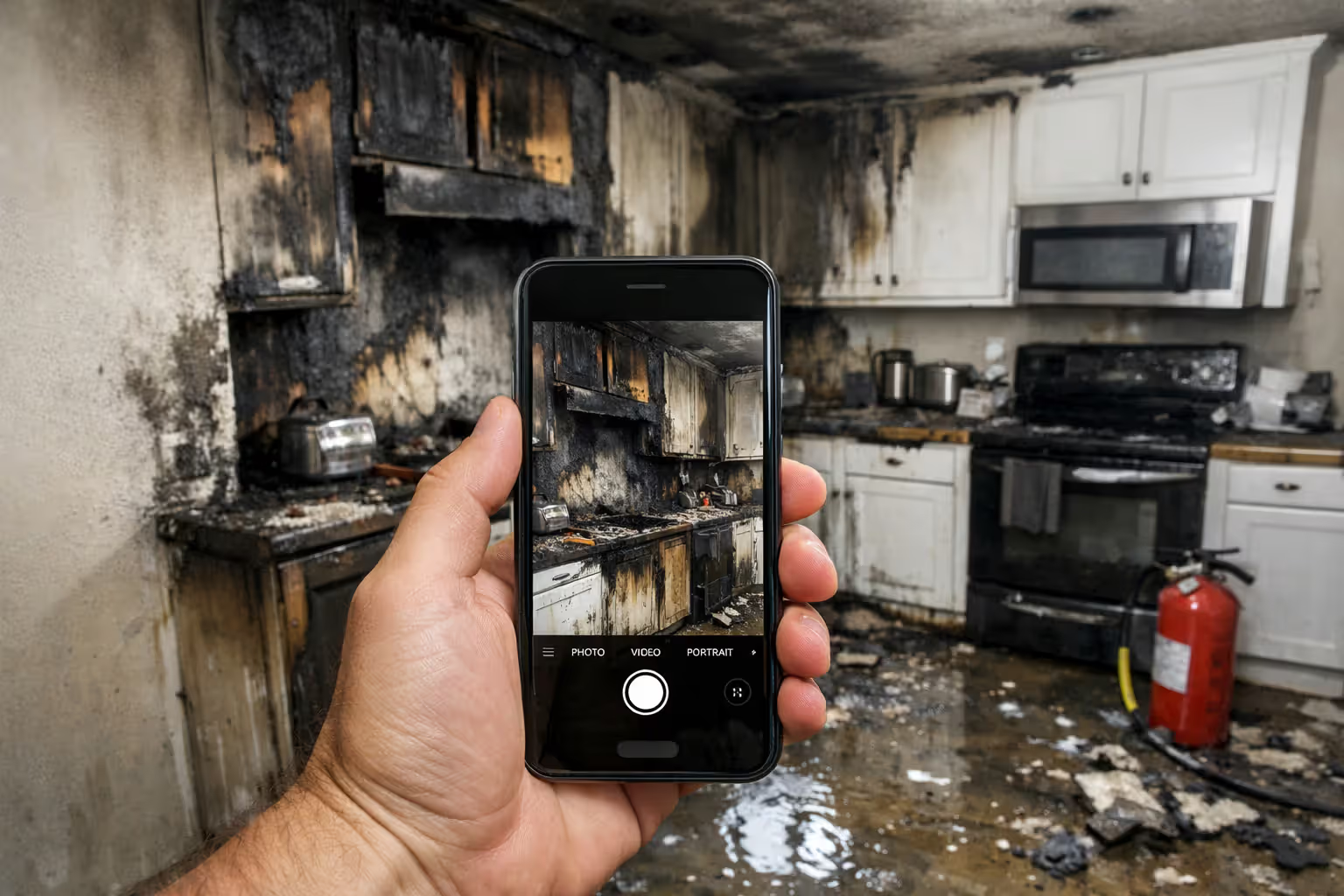
Step 1: Document everything immediately with photos and video. Before touching anything, pull out your phone. Shoot wide angles showing overall damage, then close-ups of specific problems. Video works even better—walk through damaged areas narrating what you see. Capture serial numbers on damaged appliances and electronics.
Author: Trevor Whitfield;
Source: talero.spotpariz.net
Make a written list of every damaged item: description, approximate age, what you paid (estimate if you don't remember). This documentation proves your loss and prevents arguments later. I've seen homeowners lose thousands because they cleaned up first and couldn't prove the extent of damage.
Step 2: Stop additional damage from getting worse. Every policy includes language requiring you to protect the property from further loss. Broken window from a storm? Board it up before rain soaks your floors. Burst pipe flooding your basement? Shut off the water main. Tarp your roof if it's leaking. Save every receipt—these emergency protection costs typically get reimbursed.
Don't make permanent repairs yet. The adjuster needs to see the actual damage, not your contractor's fresh work. Making repairs before inspection gives insurers ammunition to deny or reduce your claim.
Step 3: Call your insurance company within 24-48 hours. Most policies say "prompt notice" or "immediate notification" without defining exact deadlines. Don't test the limits—call within a day or two maximum. You'll need your policy number, the date and time damage occurred, and a basic description of what happened.
The company assigns your claim a number and designates an adjuster. Get that claim number and the adjuster's direct contact information. You'll reference that number in every future communication.
Step 4: Meet your adjuster and document everything discussed. The adjuster schedules a property inspection—usually within a week for urgent claims, potentially longer during catastrophe events affecting thousands of properties. Be present for this inspection. Don't assume they'll spot every issue during a 45-minute walkthrough.
Point out all damage yourself. Reference your photos and documentation. If you disagree with their assessment or they miss something, speak up immediately. You can hire a public adjuster (who represents you, not the insurance company) if the claim is complex or you suspect lowballing. Public adjusters typically charge 10-15% of the settlement but often recover more than their fee through better negotiations.
Step 5: Review settlement offers carefully before accepting. You'll receive a written estimate and settlement amount. Many companies split this into two payments: actual cash value up front (minus depreciation and your deductible), then the held-back depreciation after you complete repairs and submit contractor invoices.
Read that estimate line by line. If your contractor's quote exceeds the insurance estimate, submit a supplemental claim immediately. Most adjusters expect supplements—construction costs vary and hidden damage appears during repairs.
Step 6: Complete repairs and submit all documentation for final payment. Hire licensed, insured contractors. Keep copies of every invoice, receipt, and contract. Submit these to your insurance company to receive the depreciation holdback. Some companies require original receipts, so make copies before sending anything.
Common mistakes that torpedo claims:
- Disposing of damaged items before the adjuster sees them
- Starting permanent repairs before inspection approval
- Missing documentation deadlines buried in your policy
- Accepting initial settlements without comparing against actual contractor bids
- Failing to read policy exclusions before assuming coverage
- Not following up when the company goes silent
Simple claims might resolve in 30-60 days. Complex losses, disputed coverage, or catastrophe events can stretch six months or longer. Hurricane and wildfire seasons overwhelm adjusters, creating bottlenecks that delay everything.
Types of Homeowners Insurance Coverage and What They Protect
| Coverage Type | What It Protects | Standard Limits | Lenders Require This? |
| Dwelling | House structure, attached additions, built-in systems | Rebuilding cost ($200K-$600K depending on home) | Yes, always |
| Personal Property | Belongings inside: furniture, clothes, electronics | Half to 70% of dwelling amount | Not required, but you'll regret skipping it |
| Liability | Legal responsibility when others get injured or property damaged | $100K-$500K (adjust based on assets) | Usually $100K minimum |
| Additional Living Expenses | Hotels, meals, storage when home is unlivable | 20-30% of dwelling coverage | Commonly required |
| Medical Payments | Guest injuries regardless of who's at fault | $1,000-$5,000 | No |
| Other Structures | Detached garage, shed, fence, standalone buildings | 10% of dwelling amount | If these structures secure the loan |
Risks of Not Having Homeowners Insurance
Dropping coverage or going without insurance exposes you to financial catastrophes that few Americans can absorb.
You're betting your net worth against disasters. A moderate house fire causing $85,000 in damage requires immediate cash. You either have it or you don't. A total loss from fire or tornado means rebuilding costs of $300,000-600,000 depending on your home's size and local construction expenses. Almost no homeowners keep that kind of money liquid. Without insurance proceeds, you either drain retirement accounts (triggering taxes and penalties) or walk away from the property entirely.
Liability lawsuits can destroy you financially. A guest falls down your stairs and suffers a traumatic brain injury. Their medical costs exceed $400,000. They sue for $1.2 million covering medical bills, lost earnings, and pain and suffering. Without insurance, you're personally liable for the full judgment. Plaintiffs can garnish wages, seize investment accounts, and force property sales to collect. Some states protect certain assets, but you'll spend years in financial devastation.
Mortgage default triggers if you're required to carry coverage but don't. Your mortgage paperwork includes an insurance clause requiring continuous coverage. Let it lapse and your lender will typically give you 30-45 days to reinstate before purchasing force-placed insurance. That coverage costs 200-300% of normal rates—sometimes $5,000-8,000 annually instead of $1,500-2,000.
Force-placed insurance only protects the lender's interest. Your belongings, liability exposure, and additional living expenses get zero coverage. Keep ignoring the situation and your lender can declare the entire loan in default, demanding immediate full repayment.
The inability to rebuild destroys homeowners financially. Imagine a total loss from fire. Your $300,000 home is gone. You still owe $215,000 on your mortgage. Without insurance proceeds, you must continue making monthly mortgage payments on a pile of ashes while simultaneously paying rent somewhere else. Most homeowners can't sustain double housing costs.
Within months, you'll stop making mortgage payments. Foreclosure proceedings start. Your credit gets destroyed. You potentially owe the difference if the foreclosure sale doesn't cover your loan balance. Many homeowners in this situation file bankruptcy.
The premium savings never justify the risk. Annual homeowners insurance averages $1,500-2,500 nationally—roughly $125-210 monthly. Over 30 years, you'll pay $45,000-75,000 in premiums assuming no rate increases. Seems expensive until you consider the alternative.
The probability of experiencing a significant loss over 30 years? Quite high. Insurance industry data shows roughly 1 in 15 homeowners file a claim annually. Over three decades, you're more likely than not to face at least one major loss. Even if you beat the odds and never file a major claim, the peace of mind and protection against catastrophic scenarios provides value that eclipses the premium cost.
Think about it differently: saving $2,000 annually by dropping coverage puts $20,000 in your pocket over ten years. One serious kitchen fire causing $70,000 in damage wipes out your entire savings and leaves you $50,000 in the hole. The math doesn't work.
I get homeowners asking whether they can finally drop insurance after paying off their mortgage. Here's what I tell them: your lender required coverage to protect their money. You need it to protect yours. The day you own your home outright, you have more at stake, not less. That's the absolute worst time to cut coverage. I've seen people lose everything—homes they owned for 20 years—because they saved $150 a month by dropping insurance, then faced a $300,000 total loss
— Patricia Mendez
Frequently Asked Questions About Homeowners Insurance Requirements
Homeowners insurance isn't legally required if you own your property outright, but mortgage lenders make it mandatory to protect their collateral. That requirement ends the day you pay off your loan—but the financial protection actually becomes more critical, not less, at that point.
Grasping how coverage works—the different protection types, how deductibles affect costs, why limits matter, and what the claims process actually looks like—helps you make smarter decisions about protecting your biggest asset. The $1,500-2,500 annual cost seems expensive until you compare it against the $300,000-500,000 catastrophic loss you'd personally fund without insurance.
Whether you're carrying coverage because your lender demands it or choosing to maintain it after payoff, adequate protection shields your largest investment and prevents financial disasters that could wipe out decades of wealth accumulation. Review your policy every year, adjust coverage when your home's value or contents change, and maintain continuous protection to avoid coverage gaps that leave you vulnerable right when disaster strikes.